LeBron James has built one of the greatest careers in the history of professional sports. Whether someone believes he is the greatest basketball player of all time or places him behind another legend, there is little debate about his impact on basketball and American culture. Four NBA championships, four MVP awards, becoming the NBA’s all-time leading scorer, more than two decades of elite performance, building a billion-dollar business empire, opening the I PROMISE School for children in his hometown, and using his platform to advocate for voting rights, education, criminal justice reform, and racial equality have made him one of the most influential athletes of his generation.
His legacy extends far beyond basketball.
Yet there is one chapter of his career that has quietly faded from public discussion despite being one of the most revealing moments about power, ownership, race, and accountability in professional sports.
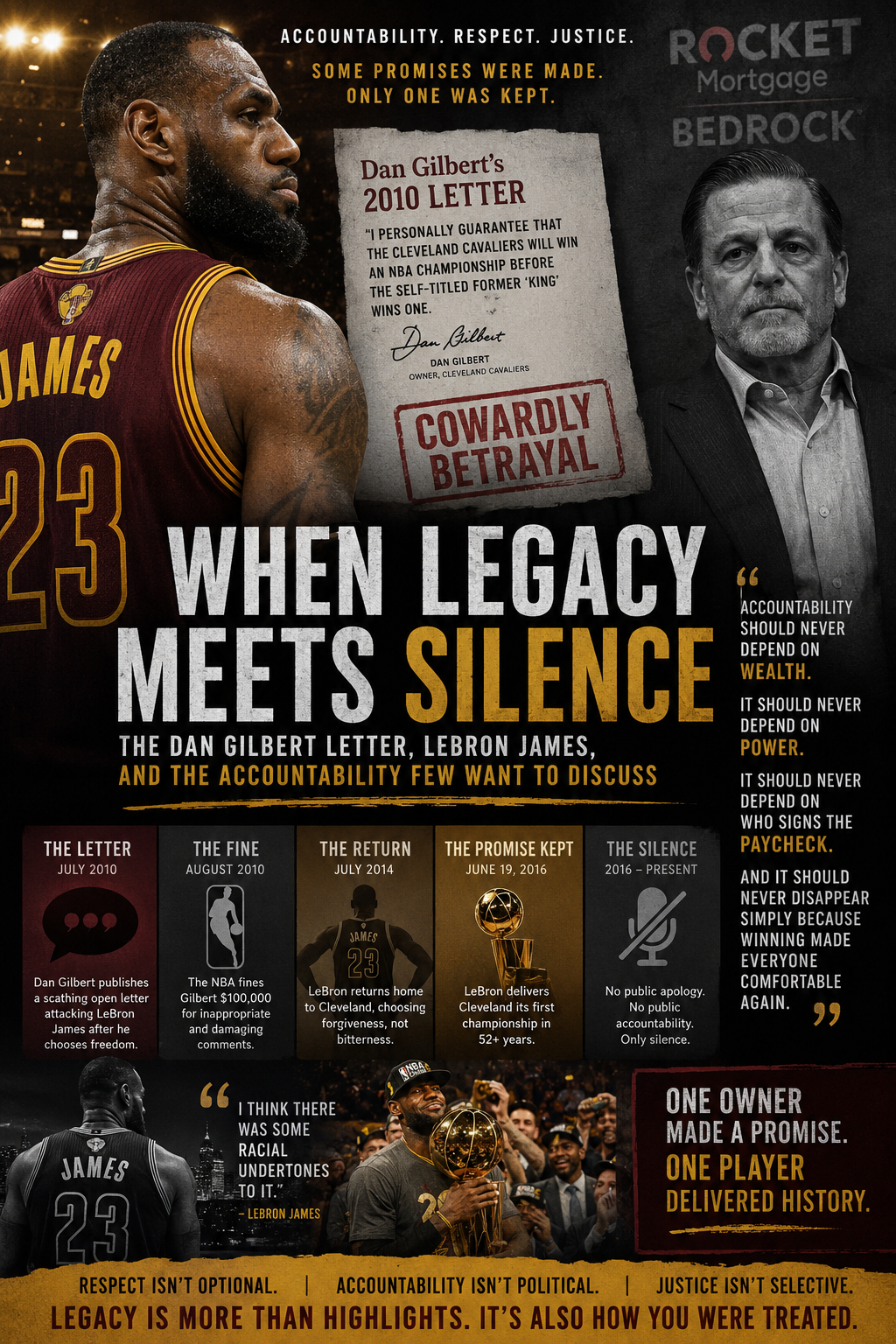
That chapter is Dan Gilbert’s infamous 2010 open letter.
It is a story many basketball fans remember only vaguely, while younger fans may not know it happened at all. For those who loudly defend LeBron every day on social media, it raises an uncomfortable question.
Why has one of the most public attacks on LeBron James by an NBA owner become one of the least discussed moments of his career?
The Letter That Should Never Have Been Written
When LeBron James announced on “The Decision” that he was leaving the Cleveland Cavaliers to sign with the Miami Heat, the reaction across Northeast Ohio was emotional. Fans burned jerseys, sports talk radio exploded, and disappointment consumed Cleveland.
But disappointment from fans is one thing.
What came from Cavaliers owner Dan Gilbert was something entirely different.
Within hours of LeBron’s announcement, Gilbert published an open letter on the Cavaliers’ official website that attacked James personally rather than professionally. He referred to him as a “former hero,” accused him of displaying “cowardly betrayal,” questioned his loyalty and character, and famously guaranteed that the Cavaliers would win an NBA championship before LeBron ever did.
The language was emotional, personal, and vindictive. It did not read like a statement from the owner of a professional sports franchise. It read like someone who believed an employee had no right to choose where he wanted to work.
The NBA itself recognized that Gilbert had crossed a line. Commissioner David Stern fined Gilbert $100,000, calling portions of the letter inappropriate.
Yet while the fine made headlines, the larger conversation about the relationship between ownership, player empowerment, and public respect slowly disappeared.
Imagine If the Roles Were Reversed
One of the easiest ways to understand why this moment remains significant is to simply reverse the roles.
Imagine if LeBron James had publicly released a letter attacking Dan Gilbert’s competence as an owner.
Imagine if he questioned Gilbert’s integrity, called him a coward, mocked his leadership, and publicly guaranteed that Gilbert’s organization would never succeed without him.
Imagine if LeBron had written that on his personal website immediately after leaving Cleveland.
The reaction would have been immediate and overwhelming. Sports television would have debated it for weeks. Sponsors likely would have weighed in. Former players would have criticized him. Many fans would have questioned his professionalism.
Instead, the criticism flowed in the opposite direction.
It came from a billionaire owner toward an employee who simply exercised a right guaranteed under the NBA’s collective bargaining agreement.
That difference matters because power matters.
Was It Simply Anger?
Supporters of Dan Gilbert often defend the letter by saying he was emotional.
Perhaps he was.
The city had just watched its hometown superstar leave after seven seasons without delivering a championship. Cleveland fans were devastated, and Gilbert himself was embarrassed.
Emotion is understandable.
But leadership is tested precisely during emotional moments.
Anyone can remain composed when things are going well. The true measure of leadership often comes when disappointment and frustration take over.
Gilbert was not simply another fan venting on social media.
He was the owner of the franchise.
His words represented the organization.
Because of that, his responsibility was greater than everyone else’s.
Instead of calming the situation, he escalated it.
LeBron Believed Race Played a Role
Years later, LeBron James reflected on Gilbert’s letter and acknowledged what many observers had debated from the beginning.
He believed race played a role.
LeBron suggested that some of the language used against him reflected stereotypes that Black athletes have historically faced whenever they exercise independence and challenge traditional power structures.
Whether every reader agrees with that conclusion or not, it deserves thoughtful consideration.
American history is filled with examples of Black athletes being described as ungrateful, disloyal, selfish, or arrogant simply for demanding control over their own careers.
Muhammad Ali was condemned for refusing military service.
Curt Flood was criticized for challenging baseball’s reserve clause.
Craig Hodges found himself effectively pushed out of the NBA after delivering a letter to the White House addressing racial inequality.
Mahmoud Abdul-Rauf faced enormous backlash for peacefully protesting during the national anthem.
Colin Kaepernick’s career effectively ended after kneeling to protest police brutality.
LeBron himself has often spoken about these historical patterns.
Ironically, one of the clearest examples involving his own career rarely receives the same level of discussion.
The Private Apology
To be fair, supporters of Dan Gilbert often point out that he eventually apologized.
That is true.
Before LeBron returned to Cleveland in 2014, Gilbert reportedly met privately with James, expressed regret, and apologized face to face. Gilbert later admitted publicly that he wished he had never written the letter.
Private reconciliation matters.
If LeBron accepted that apology personally, that was entirely his decision.
Forgiveness is personal.
But public accountability is different.
The original attack was public.
It was posted on the Cavaliers’ official website.
Millions of people read it.
Sports networks discussed it.
Fans repeated its language for years.
It became part of NBA history.
So a reasonable question remains.
If the attack was public, should the apology have been equally public?
Reasonable people can disagree on that answer.
But the question itself remains legitimate.
The Championship That Changed Everything
Perhaps the greatest irony in this entire story is how history unfolded.
Dan Gilbert publicly guaranteed that the Cavaliers would win an NBA championship before LeBron James ever won one.
Instead, LeBron won two championships with Miami.
Then, in one of the most remarkable decisions in sports history, he returned to Cleveland.
Rather than holding onto resentment, he came back home with the stated mission of bringing a championship to the city.
In 2016, he fulfilled that promise.
After overcoming a 3-1 deficit against the Golden State Warriors, LeBron delivered Cleveland its first NBA championship and its first major professional sports title in more than fifty years.
The owner who publicly criticized him never fulfilled his own guarantee.
The player he criticized fulfilled it for him.
History has a remarkable way of humbling certainty.
Why Didn’t More Fans Demand Accountability?
This may be the most uncomfortable part of the conversation.
LeBron has one of the most passionate fan bases in sports.
His supporters challenge media criticism, defend his accomplishments, and passionately argue his case in the greatest-of-all-time debate.
Yet comparatively few continue asking about Dan Gilbert’s letter.
Why?
If accountability truly matters, shouldn’t it apply consistently?
Why do fans remember every controversial comment from television personalities while largely forgetting one of the harshest public condemnations ever written by an NBA owner about his own player?
This is not about criticizing LeBron fans.
It is about asking whether our principles change depending on who is involved.
Consistency is often the hardest standard to maintain.
LeBron’s Silence
Another difficult question deserves thoughtful discussion.
Throughout his career, LeBron has become one of the most influential athlete-activists of the modern era. He has spoken forcefully on issues involving racial injustice, police violence, voting rights, educational equity, and economic opportunity. Millions admire him because he has consistently used his platform for causes larger than basketball.
That makes this chapter of his own story particularly interesting.
After returning to Cleveland, LeBron rarely revisited Gilbert’s letter publicly. While he later acknowledged believing the comments contained racial undertones, he never publicly demanded a broader apology or made Gilbert’s words a central issue after rejoining the organization.
There are many possible explanations.
Perhaps he believed reconciliation was more important than continuing conflict.
Perhaps bringing a championship to Cleveland mattered more than revisiting old wounds.
Perhaps he chose forgiveness.
Those are understandable choices.
But they also leave room for an honest discussion about whether public accountability should still matter when the offense directly affects the person advocating for justice.
Fans Should Be Consistent
Sports have a way of exposing selective accountability.
Some people defend players until those players leave their favorite team.
Others defend owners regardless of how they treat athletes.
Still others passionately demand accountability only when the person involved is someone they already dislike.
Real consistency is much harder.
If someone believes athletes deserve respect, then that respect should exist whether they stay or leave.
If someone believes racism and discrimination should always be challenged, then those conversations should not disappear simply because a championship was eventually won.
If someone believes public harm deserves public accountability, then that principle should apply equally to billionaires, owners, executives, coaches, and players alike.
Justice loses credibility when it becomes selective.
A Legacy Bigger Than Basketball
None of this diminishes LeBron James’ extraordinary legacy.
If anything, it highlights just how remarkable his journey truly was.
He returned to an organization whose owner had publicly embarrassed him.
He brought that city its first championship in more than half a century.
He restored hope to a fan base that had waited generations.
He fulfilled a promise that ownership itself could not.
Those accomplishments deserve to be celebrated.
But history should remember the entire story.
It should remember LeBron James as one of the greatest basketball players who ever lived.
It should also remember that one of the game’s greatest athletes was publicly attacked by his own employer simply for exercising a contractual right every free agent possesses.
Whether someone believes Dan Gilbert’s private apology was enough or believes the public deserved the same level of accountability as the original attack, the larger lesson remains timeless.
Accountability should never depend on wealth.
It should never depend on power.
It should never depend on who signs the paycheck.
And it should never disappear simply because winning eventually made everyone comfortable again.
Source Reference: https://www.espn.com/nba/news/story?id=5365704