Stephen A. Smith has made a career out of demanding accountability.
Coaches must answer for losing. Players must answer for poor performances. Executives must answer for bad decisions. Politicians must answer for failed leadership. Athletes making millions of dollars are routinely reminded by Smith that criticism comes with the territory.
Now the microphone has been turned toward him.
And suddenly, accountability appears to feel a little different.
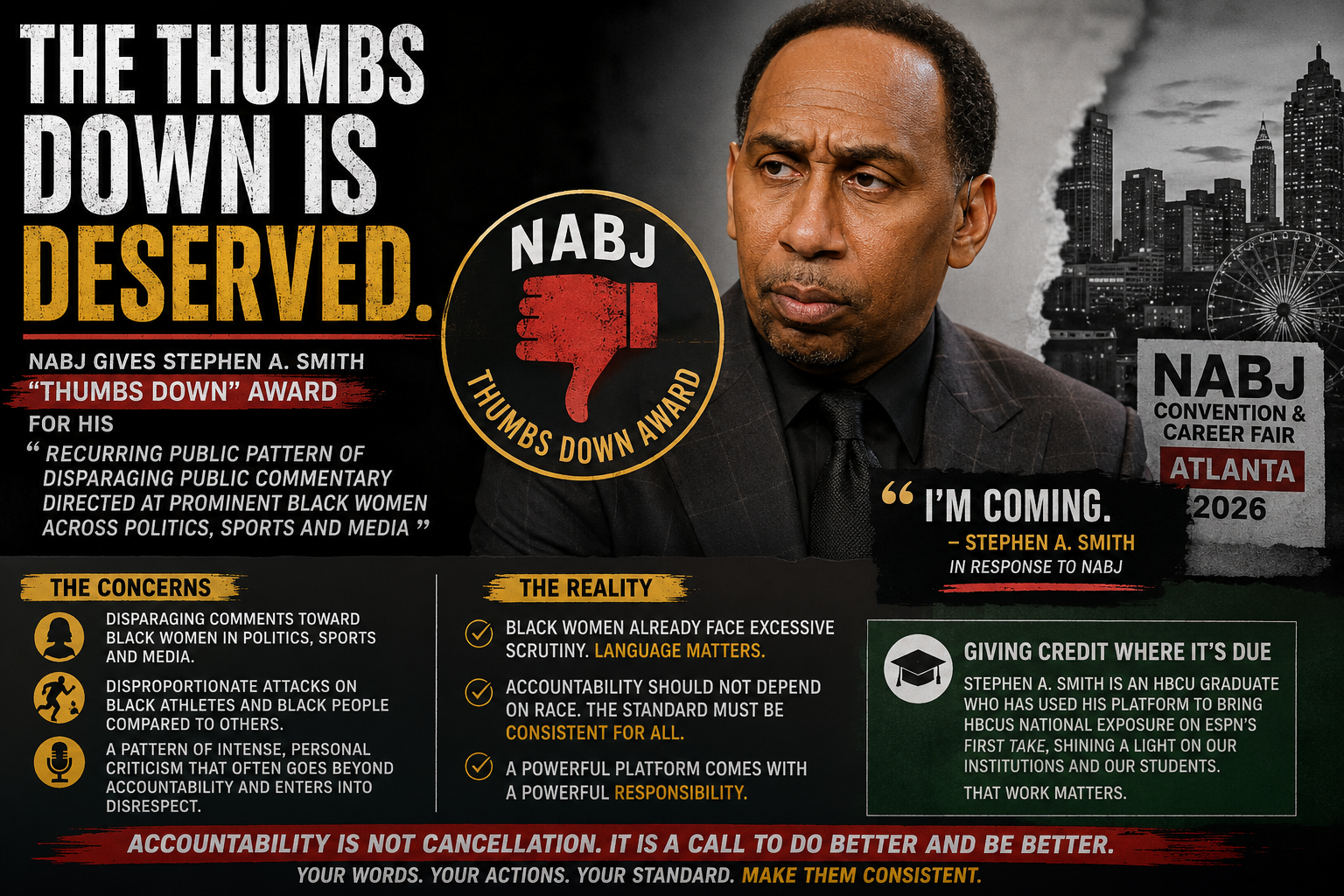
At its 2026 convention in Atlanta, the National Association of Black Journalists gave Smith its Thumbs Down Award, an honor NABJ describes as being reserved for individuals or organizations responsible for especially insensitive, racist or stereotypical coverage or commentary about the Black community, or conduct contrary to the organization’s goals. (NABJ)
NABJ specifically accused Smith of establishing a recurring pattern of disparaging commentary toward prominent Black women across politics, sports and media, saying such commentary can reinforce harmful narratives and undermine fair representation of Black women. NABJ President Errin Haines emphasized that the award was not simply condemnation. She described it as “a call to do better.” (EssentiallySports)
That distinction matters.
Because Stephen A. Smith does not need to be canceled.
He needs to listen.
Smith’s Response Illustrates the Problem
Smith responded to the award by warning NABJ that his response was coming.
He wrote that NABJ had taken its turn and that his was next, adding: “I’m coming.” Smith suggested that when he was finished responding, people could decide who really deserved a Thumbs Down Award regarding the Black community. (EssentiallySports)
That is his right.
He has every right to challenge NABJ’s decision, defend his record, dispute its characterization of his commentary and criticize the organization.
But there is another option available to him.
Reflection.
What if, instead of immediately preparing for war with NABJ, Smith asked why an organization dedicated to Black journalists reached this conclusion?
What if he asked why Black athletes, Black journalists, Black women and other Black public figures have increasingly questioned whether the intensity of his criticism is distributed equally?
That does not mean every criticism of a Black person is anti-Black.
It does not mean Black journalists cannot criticize Black athletes.
It certainly does not mean Black women politicians should be protected from legitimate scrutiny.
It means the standard should be consistent.
The Question Is Not Whether Stephen A. Criticizes Black People
The more important question is how he criticizes them and whether the same rhetorical artillery is consistently deployed against everyone else.
Former NBA player Etan Thomas raised precisely that issue in a May 2026 Guardian column. Thomas credited Smith for supporting HBCUs and generating scholarship opportunities while arguing that Smith too frequently attacks Black male athletes with a level of intensity Thomas believes is not equally directed toward white athletes and executives. Thomas specifically cited Kyrie Irving, Kwame Brown, LeBron James, Terrell Owens and Kevin Durant. (The Guardian)
That criticism deserves consideration because the list is not insignificant.
Smith’s very public feud with LeBron James became especially personal in 2025 after James confronted him regarding commentary about his son Bronny. Smith later called James “weak” and continued escalating the dispute. During another response, Smith incorrectly suggested James had not attended Kobe Bryant’s memorial before acknowledging his mistake and apologizing. (Los Angeles Times)
When commentary moves beyond analyzing somebody’s performance and becomes personal, journalists and commentators should ask whether the heat is illuminating the subject or simply generating another viral clip.
Smith has built an enormous platform partly because he understands television better than almost anybody in sports media.
But with enormous reach comes enormous responsibility.
Black Women Should Not Be Everybody’s Easiest Political Target
NABJ’s criticism focuses particularly on Smith’s treatment of prominent Black women.
That conversation cannot simply be dismissed as people being too sensitive.
Smith has criticized Black women in politics, including Kamala Harris and Jasmine Crockett. To his credit, he later apologized to Crockett and said he did not personally feel negatively toward her, Harris or Michelle Obama. (Fox News)
And fairness requires acknowledging something else: Smith has also spoken favorably about Crockett. In a February 2026 CNN appearance, he said he believed Crockett was the strongest Democratic candidate in the Texas race being discussed and praised her willingness to fight Republicans. (CNN Transcripts)
That complexity matters.
This should not become an article pretending Stephen A. Smith has never supported a Black woman or has spent his entire career attacking Black people.
That would be inaccurate.
The issue is the pattern, tone and proportionality of his commentary.
Black women already operate inside political, corporate, academic, media and sports environments where their competence, temperament, appearance, intelligence and qualifications can receive extraordinary scrutiny. A Black commentator does not have to protect Black women from criticism, but he should understand the historical and cultural weight attached to the language used against them.
Accountability and respect can exist simultaneously.
And What Happens When the Powerful Person Across the Table Is Not Black?
There is another part of this conversation that deserves nuance.
It would be inaccurate to say Smith never confronts President Donald Trump. In April 2026, Smith publicly argued that the country needed a new president, and he has criticized Trump’s leadership and policies. He has also responded publicly when Trump attacked him. (Yahoo Sports)
So the criticism should not be that Stephen A. Smith is literally silent about Trump or other powerful white figures.
The better question is whether the tone, persistence and personal intensity are comparable.
That is where viewers should examine the record for themselves.
When Black athletes or Black public figures become Smith’s targets, the criticism can stretch across shows, podcasts, interviews and multiple news cycles. Disagreements can become personal confrontations. Names can become recurring subjects.
That is the inconsistency critics are challenging.
If your standard is accountability, apply it everywhere.
If politicians deserve smoke, everybody gets smoke.
If athletes deserve scrutiny, everybody gets scrutiny.
If disrespect deserves outrage, everybody’s disrespect deserves outrage.
The credibility of commentary depends upon the consistency of the standard.
We Cannot Ignore What Stephen A. Smith Has Done Right
Criticism should also be intellectually honest.
Stephen A. Smith is a graduate of Winston-Salem State University, and his commitment to bringing HBCUs onto national television deserves recognition.
Under Smith’s leadership on First Take, ESPN has repeatedly broadcast from or highlighted historically Black colleges and universities. In 2024, the show scheduled appearances at Howard University, Tennessee State University and Clark Atlanta at Morehouse College. In 2025, ESPN announced its largest HBCU fall schedule to that point, with appearances involving Norfolk State, the Magic City Classic, Delaware State and Bethune-Cookman. (ESPN Press Room)
Smith also helped bring First Take to Winston-Salem State and Savannah State in 2023. ESPN credited Smith’s commitment to his alma mater and HBCUs as an important part of the effort. (ESPN Press Room)
That exposure matters.
Putting HBCUs before ESPN’s massive national audience matters.
Promoting Black institutions matters.
Showing young Black journalism students that somebody who graduated from an HBCU can become one of America’s most powerful sports-media personalities matters.
Those contributions should not disappear simply because Smith deserves criticism elsewhere.
Two things can be true simultaneously.
Stephen A. Smith has done meaningful work benefiting Black institutions.
Stephen A. Smith can also deserve serious criticism from Black journalists.
Accountability Is Not Cancellation
This is where Smith should reconsider what the NABJ award represents.
The Thumbs Down Award does not erase his career.
It does not revoke his degree.
It does not eliminate his contributions to HBCUs.
It does not say he cannot criticize Black athletes, Black politicians or Black women.
It says something much simpler:
Do better.
That is essentially how NABJ’s president framed it herself. The organization’s message was that the door remained open for conversation and change. (EssentiallySports)
That should matter to someone who has spent decades demanding that other people answer criticism rather than run from it.
Stephen A. Smith frequently tells athletes that their salaries, celebrity and influence make scrutiny unavoidable.
The same standard applies to him.
You cannot build a multimillion-dollar career telling everybody else to accept criticism and then treat institutional criticism of you as a declaration of war.
You cannot demand accountability from athletes Monday through Friday and view accountability directed toward yourself as disrespect.
You cannot constantly tell other people that their words and actions have consequences while pretending your own words exist without cultural consequences.
Stephen A., Use the Mirror Before the Microphone
Smith does not have to agree with NABJ.
He should challenge factual inaccuracies if any exist.
He should defend himself where he believes the criticism is unfair.
But after doing that, he should also examine whether there is something worth learning.
Because when enough people from the community you say you fight for begin telling you that something about your approach is hurting that community, the answer cannot always be that everybody else misunderstood you.
Sometimes leadership means listening when the criticism hurts.
Sometimes growth means acknowledging that intentions and impact are not always identical.
Sometimes accountability means realizing that accomplishments do not purchase immunity from criticism.
Stephen A. Smith has accomplished something remarkable. A Black man from an HBCU became one of the most recognizable, influential and highly compensated personalities in American sports media. He has kicked open doors, promoted HBCUs and demonstrated what is possible for generations coming behind him.
That makes this conversation more important, not less.
Because his microphone is enormous.
His words travel.
His clips travel farther.
And when those words concern Black athletes, Black women, Black politicians or anybody else whose reputation can be shaped by national media narratives, the responsibility accompanying that microphone must be equally enormous.
The NABJ Thumbs Down Award should not be viewed as the Black journalism community declaring Stephen A. Smith its enemy.
It should be viewed as a challenge.
Be as fearless questioning powerful white politicians as you are criticizing Black politicians.
Be as relentless scrutinizing white athletes and executives as you are scrutinizing Black athletes.
Be as thoughtful discussing Black women as you expect others to be when discussing people you care about.
Keep supporting HBCUs.
Keep opening doors.
Keep challenging athletes.
Keep challenging politicians.
Keep speaking your mind.
But make the standard consistent.
Because equality in journalism cannot mean equal opportunity to speak while allowing unequal standards for who receives the harshest criticism.
Stephen A. Smith has spent years telling athletes that greatness comes with expectations.
Now one of the nation’s most important organizations representing Black journalists has placed an expectation on him.
The appropriate response should not simply be, “I’m coming.”
It should also be:
I’m listening.
And if the criticism has merit, I’m going to do better.