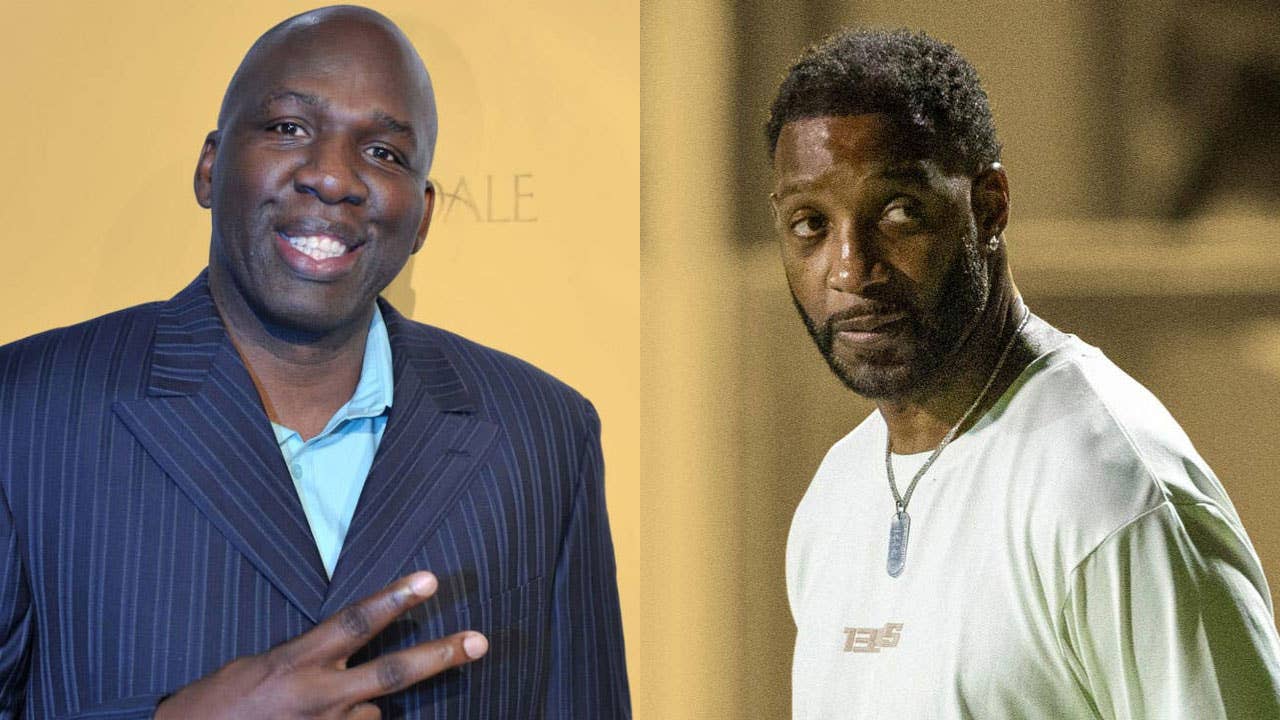
Former NBA center Olden Polynice has had enough of the ongoing debate over whether an NBA regular-season MVP carries more weight than winning a championship.
Polynice didn’t simply disagree with Tracy McGrady’s controversial position.
He went all the way in.
Appearing on Byron Scott’s Fast Break, Polynice blasted McGrady’s argument that an MVP should be considered more valuable than an NBA championship, calling it the kind of thinking associated with players who didn’t win it all.
“T-Mac I’ve never read your book, ‘Things Losers Say.’ Because that’s what it is. I’m sick and tired.”
The comments have reignited one of the NBA’s oldest debates: What matters more when evaluating a player’s career — individual greatness or championships?
Tracy McGrady Believes MVPs Mean More Than Championships
The controversy began after McGrady recently argued that the regular-season MVP is more valuable than an NBA championship because the MVP is an individual accomplishment.
“The MVP of the regular season has more weight than a championship,” McGrady said.
His reasoning is that winning a championship is a collective accomplishment involving much more than the best player on the roster.
Ownership, management, coaching, teammates, injuries and roster construction can all determine whether a team ultimately wins the Larry O’Brien Trophy.
An MVP, meanwhile, directly recognizes an individual player’s performance over an entire regular season.
McGrady also pointed out that fans often remember the superstar who won the championship but may not remember the role players who were part of the team.
That argument clearly didn’t sit well with Polynice.
Olden Polynice: “Championships Matter”
Polynice pushed back hard against the idea that an MVP should carry more weight than a championship.
“Championships matter,” Polynice said.
He then used an example involving former Chicago Bulls center Jack Haley to make his point.
“We don’t know who the 12th man is, but guess what? Jack Haley had three rings and he can carry that ring anywhere and show it and get stuff from it. Nobody gives damn about no damn MVPs.”
There is one important correction to Polynice’s example: Haley won one NBA championship, with the 1995-96 Chicago Bulls, rather than three.
But the larger point remains clear.
For Polynice, the championship represents the ultimate achievement because it is the culmination of an entire season and postseason.
Byron Scott Sides With Polynice
Polynice wasn’t the only former NBA player pushing back against McGrady.
Byron Scott, a three-time NBA champion with the Showtime Lakers, also argued that championships carry greater significance.
Scott pointed to Charles Barkley as an example.
Barkley won the 1993 NBA MVP but never captured an NBA championship during his Hall of Fame career.
Scott believes Barkley would gladly trade his MVP award for a championship ring.
And that’s ultimately the heart of the disagreement.
McGrady is measuring individual achievement. Polynice and Scott are measuring ultimate team success.
McGrady’s Own Career Makes This Debate Even More Interesting
The discussion is especially intriguing because McGrady understands firsthand what it means to have an extraordinary individual résumé without a championship.
The Hall of Famer was a seven-time All-Star, seven-time All-NBA selection and two-time scoring champion. He also averaged 32.1 points per game during the 2002-03 season.
But McGrady never won an NBA championship and never won the regular-season MVP award.
His teams also struggled to advance deep into the postseason, although injuries to McGrady and key teammates played a major role in his playoff history.
McGrady has previously pushed back against the criticism surrounding his lack of championships, arguing that winning a title requires a great team and some degree of luck.
That’s what makes his current MVP argument so personal.
He’s essentially arguing that a player’s individual accomplishments shouldn’t be diminished simply because the circumstances around him prevented a championship.
The Real Question: Can an MVP Really Be Worth More Than a Ring?
This is where the debate gets complicated.
There is a legitimate argument for McGrady’s position.
An MVP is an individual award. One player is selected from the entire league based on his performance over an 82-game regular season.
A championship is different.
A superstar can play brilliantly and still lose because his second-best player gets injured, the front office fails to build a championship roster or another team simply proves to be better.
That’s why an MVP can arguably provide a cleaner measurement of individual dominance.
But Polynice’s argument speaks to something different: legacy.
Championships are the ultimate objective of the sport.
And while role players receive championship rings, the stars who lead their teams to those championships are remembered forever.
Michael Jordan’s six championships are inseparable from his legacy.
Kobe Bryant’s five titles are inseparable from his.
LeBron James’ four championships are a major part of his case as one of the greatest players ever.
The same goes for Magic Johnson, Larry Bird, Kareem Abdul-Jabbar, Bill Russell and countless other NBA legends.
McGrady Fires Back
The debate didn’t stop with Polynice.
McGrady has since responded to the criticism, firing back with a pointed social-media response directed at Polynice.
That response has taken what was already a fascinating basketball debate and turned it into another chapter in the growing conversation surrounding McGrady’s views on NBA greatness.
And given McGrady’s history of defending his own career against the “no rings” criticism, it probably shouldn’t come as a surprise that he isn’t backing down.
So Who’s Right?
There probably isn’t a perfect answer.
If the question is “What better measures individual regular-season dominance?”, the MVP has a strong argument.
If the question is “What is the ultimate accomplishment in the NBA?”, the championship wins easily.
The biggest issue is trying to use either accomplishment by itself to determine a player’s entire legacy.
An MVP doesn’t automatically make someone greater than a champion.
And a championship doesn’t automatically make a role player greater than an MVP.
The strongest legacy cases usually come from the combination of individual excellence, sustained dominance, playoff performance and winning.
But if you ask Olden Polynice?
There’s no debate.
Give him the rings.
And judging by his comments, he’s not interested in hearing anything else.