The NCAA is changing its timing protocol for college football replay reviews following the controversial finish to Michigan’s 13-12 victory over Western Michigan.
According to ESPN, the NCAA has issued new guidance establishing a standardized timing procedure “that ensures consistency in the administration of all college football games.”
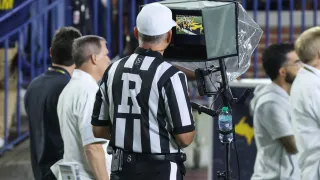
Under the new guidance, the official time for a college football game remains the time displayed on the in-stadium game clock. However, when replay officials need to restore or adjust time, they must use the embedded game clock contained within the broadcaster’s program feed.
If that embedded clock is unavailable, replay officials are instructed to use the game-clock graphic displayed as part of the broadcast feed.
“This timing protocol should be followed consistently at all institutions and game sites.”
The timing change comes just days after Michigan escaped Western Michigan in one of the most controversial endings of the young college football season.
After Michigan’s initial Hail Mary appeared to end the game, replay officials determined that Western Michigan defender Micah Davis touched the ball while out of bounds with one second remaining. The second was restored, giving Michigan another opportunity.
Bryce Underwood then connected with JJ Buchanan on a 47-yard touchdown pass, giving Michigan a 13-12 victory.
The Mid-American Conference later argued that the replay crew had used the wrong clock feed when determining whether time remained. The MAC said that had the established protocol been followed, no additional second would have been added and Western Michigan would have won 12-7.
The NCAA’s new guidance does not change Michigan’s official result. The NCAA has indicated there is no the game’s outcome.
But the timing controversy has now produced a concrete rule change.
This latest NCAA guidance adds another significant chapter to a controversy that has already seen the MAC formally appeal the game’s result. While the NCAA has indicated it does not have the authority to overturn the outcome, the new timing protocol directly addresses the replay-clock procedure at the center of the dispute.
In other words: the NCAA just made sure there won’t be another “which clock are we using?” situation like Michigan-Western Michigan.