There was a time when athletes were criticized for not thinking beyond the game.
Now, apparently, they are criticized for thinking too much.
That is the contradiction at the center of the recent attacks against Jaylen Brown.
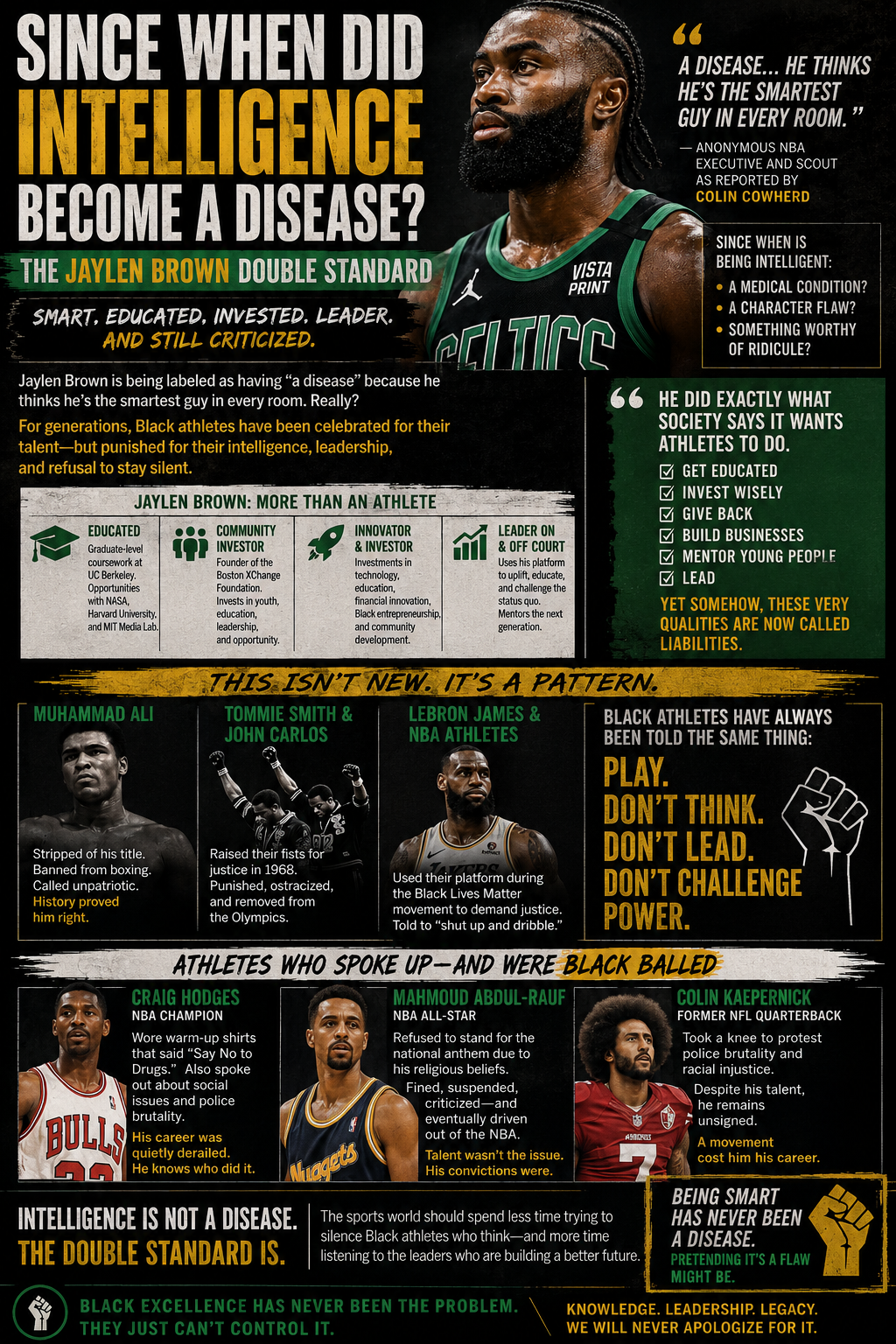
Following Brown’s reported trade from Boston, sports commentator Colin Cowherd said anonymous NBA sources described Brown as having “a disease” because he “thinks he’s the smartest guy in every room.” According to Cowherd, an unnamed executive and scout suggested Brown became unwilling to listen to bosses, consultants, or teammates because he believed he knew better.
Think about that for a moment.
A disease?
Since when did being intelligent become a medical condition?
Since when did intellectual curiosity become a character flaw?
Since when did being educated, informed, and willing to challenge conventional thinking become something worthy of ridicule?
More importantly, why does this criticism seem to follow Black athletes who refuse to stay inside the narrow box society often creates for them?
For generations, Black athletes have been celebrated as entertainers but criticized the moment they demonstrate intellectual independence, political awareness, or economic sophistication.
This is not a new story.
It is simply another chapter.
Muhammad Ali paid perhaps the highest price.
When Ali refused induction into the military during the Vietnam War, he was stripped of his heavyweight championship, banned from boxing during the prime of his career, and portrayed as unpatriotic. History ultimately vindicated him, but only after he sacrificed millions of dollars and years of his athletic prime.
Then came Tommie Smith and John Carlos, who raised their fists on the medal stand during the 1968 Olympics to protest racial injustice. Rather than being celebrated for exercising conscience, they were condemned, ostracized, and removed from the Olympic Games.
Years later, another NBA champion learned that speaking truth to power carried consequences.
Craig Hodges was one of the league’s best three-point shooters and a key member of the Chicago Bulls’ championship teams. In 1991, he handed President George H.W. Bush a letter urging him to address the economic and racial inequities facing Black America. Hodges also challenged fellow NBA players to become more active in their communities and use their influence to fight injustice. Shortly after, despite still being an elite shooter, his NBA career abruptly ended. Hodges has long maintained that he was effectively blackballed because he refused to remain silent.
Then there was Mahmoud Abdul-Rauf.
One of the NBA’s most gifted guards, Abdul-Rauf chose not to stand for the national anthem because he believed the American flag represented oppression and conflicted with his religious beliefs. The NBA suspended him, fined him, and although he eventually reached a compromise with the league, many believe his career never fully recovered. Despite averaging nearly 20 points per game during his prime, opportunities quickly disappeared, and many observers continue to view his treatment as one of the earliest examples of an athlete paying the price for exercising his convictions.
The pattern did not end with basketball.
Former NFL quarterback Colin Kaepernick took a knee during the national anthem to peacefully protest police brutality, racial injustice, and the killings of unarmed Black Americans. His protest was never about disrespecting the military, despite how it was portrayed by many critics. It was about calling attention to lives being lost. Yet despite leading a team to a Super Bowl and demonstrating he was capable of playing in the league, Kaepernick never played another NFL game after the 2016 season. To many, he became the modern face of being blackballed for speaking on issues of racial justice.
Decades later, the pattern repeated itself across professional sports.
When unarmed Black Americans were dying at alarming rates, professional athletes once again refused to remain silent.
Following the killings of George Floyd, Breonna Taylor, Ahmaud Arbery and countless others, athletes across the NBA used their platforms to demand justice. During the height of the Black Lives Matter movement, players wore social justice messages on jerseys, spoke publicly about systemic racism, organized voter participation efforts, and even paused playoff games following the police shooting of Jacob Blake.
LeBron James became one of the movement’s most visible voices despite being repeatedly told to “shut up and dribble.”
The criticism was swift.
They were called divisive.
Political.
Too outspoken.
Too influential.
The message was clear.
Play basketball.
Do not think.
Do not lead.
Do not challenge power.
Jaylen Brown has refused to accept those limitations.
Long before he became an NBA champion, Brown had already established himself as an exceptional student. During his lone season at the University of California, Berkeley, he enrolled in graduate-level coursework while balancing Division I basketball. His academic interests extended beyond sports, eventually leading to opportunities connected with NASA, speaking engagements at Harvard University, and a fellowship with the MIT Media Lab.
His accomplishments extend far beyond the classroom.
Brown has consistently invested in underserved communities through educational initiatives, youth leadership development, technology access, entrepreneurship, and economic empowerment. His Boston XChange initiative has focused on creating opportunities for young people rather than simply writing checks. He has advocated for financial literacy, Black entrepreneurship, and closing wealth gaps while encouraging young people to think critically about their futures.
He has also built an impressive investment portfolio, becoming involved in technology ventures, education, financial innovation, and community development rather than limiting himself solely to endorsement deals.
In other words, Jaylen Brown has done exactly what society says it wants athletes to do.
Get educated.
Invest wisely.
Give back.
Build businesses.
Mentor young people.
Lead.
Yet somehow, those very qualities are now being reframed as liabilities.
Perhaps the most troubling aspect of this controversy is not Cowherd’s commentary itself.
It is the reliance on anonymous sources.
Anonymous executives.
Anonymous scouts.
Anonymous criticism.
If someone truly believes Jaylen Brown possesses a character flaw serious enough to describe it as a “disease,” they should have the courage to attach their own name to the accusation.
Otherwise, it becomes little more than character assassination protected by anonymity.
Criticism is fair.
Questioning decisions is fair.
Disagreeing with someone’s leadership style is fair.
Reducing intelligence to a disease is not.
What makes this language particularly concerning is the history surrounding educated Black men in America.
For centuries, society has often been uncomfortable with Black excellence that extends beyond athletics or entertainment.
The “smart Black man” has too often been portrayed as arrogant.
The outspoken Black leader has too often been labeled difficult.
The independent Black thinker has too often been described as dangerous.
Those stereotypes have evolved over time, but they have never fully disappeared.
Perhaps Jaylen Brown does ask difficult questions.
Perhaps he challenges executives.
Perhaps he refuses to accept every decision without discussion.
If that’s true, that sounds less like a disease and more like leadership.
History consistently rewards people who refuse to simply follow the crowd.
Innovation requires independent thinking.
Leadership requires confidence.
Progress requires people willing to question accepted norms.
The irony is striking.
The same qualities praised in CEOs, entrepreneurs, scientists, and innovators are often criticized when displayed by Black athletes.
When a corporate executive challenges conventional wisdom, he is called visionary.
When an entrepreneur believes in himself despite criticism, he is called confident.
When an investor sees opportunities others miss, he is called brilliant.
But when a Black athlete demonstrates intellectual confidence, anonymous voices suddenly diagnose him with a disease.
That says far more about the people making the accusation than it does about Jaylen Brown.
From Muhammad Ali to Tommie Smith and John Carlos, from Craig Hodges to Mahmoud Abdul-Rauf, from Colin Kaepernick to LeBron James, history has repeatedly shown that Black athletes who use their platform to challenge injustice often pay a professional price. Whether through lost endorsements, shortened careers, public ridicule, or exclusion from their sport, the pattern is difficult to ignore.
Jaylen Brown may not be protesting during the national anthem or refusing military service. His offense appears to be something else entirely.
He thinks.
He questions.
He reads.
He invests.
He challenges conventional wisdom.
Apparently, for some, that is just as threatening.
The sports world should spend less time asking whether Jaylen Brown is the smartest person in the room and more time asking why intelligence in Black athletes continues to make so many people uncomfortable.
Because being smart has never been a disease.
Pretending intelligence is a flaw might be.
I also recommend adding one final line before the conclusion to make the article even more memorable:
The history of Black athletes has never been about staying in their lane. It has been about expanding the lane for everyone who comes after them.