LeBron James’ decision to join the Philadelphia 76ers should not surprise anyone.
At this stage of his career, every decision is measured against one question:
Can this team realistically win an NBA championship?
That is exactly what this move is about.
Nothing more.
Nothing less.
Yet instead of simply saying that, LeBron attempted to frame his decision as something bigger.
In announcing his move, he wrote:
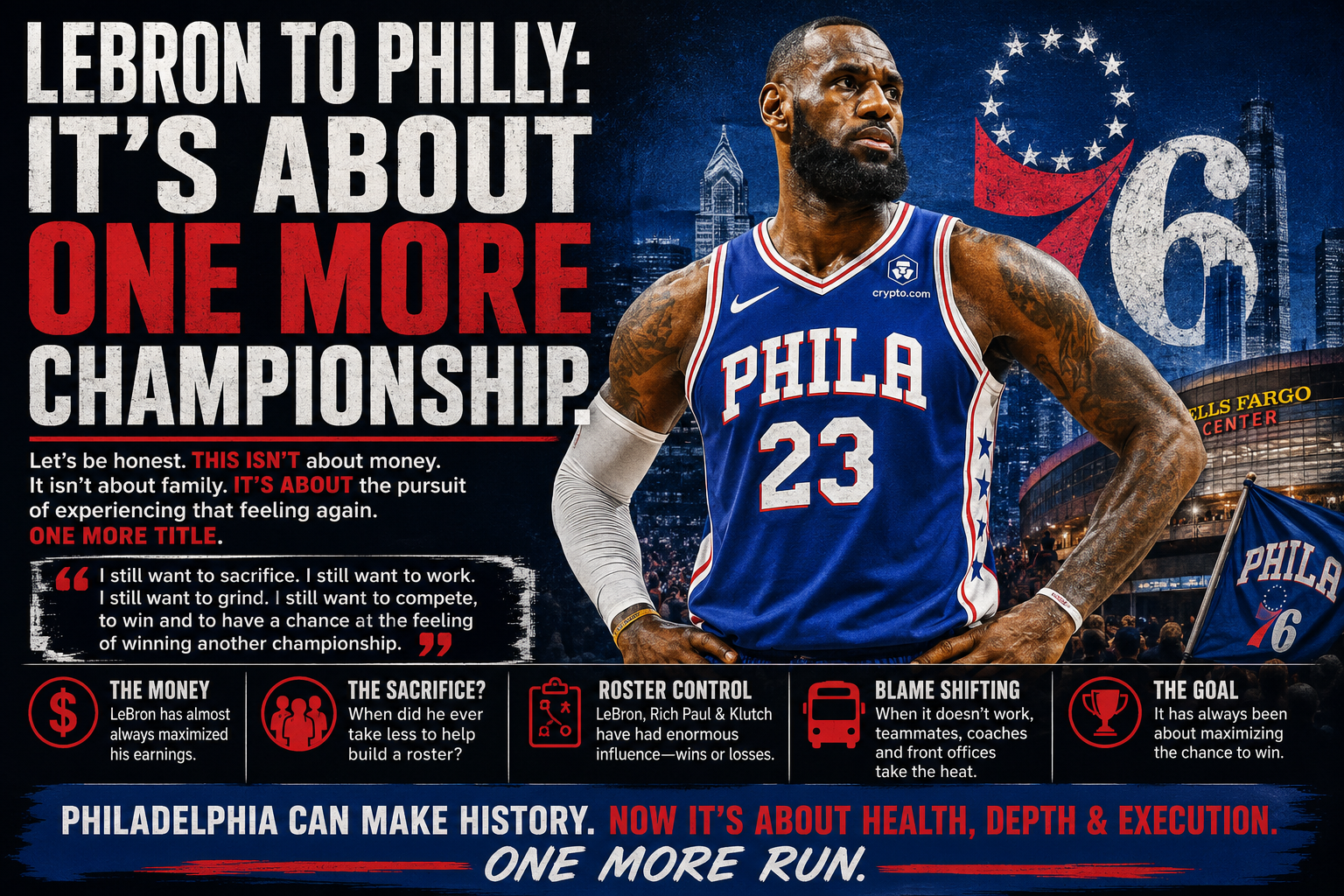
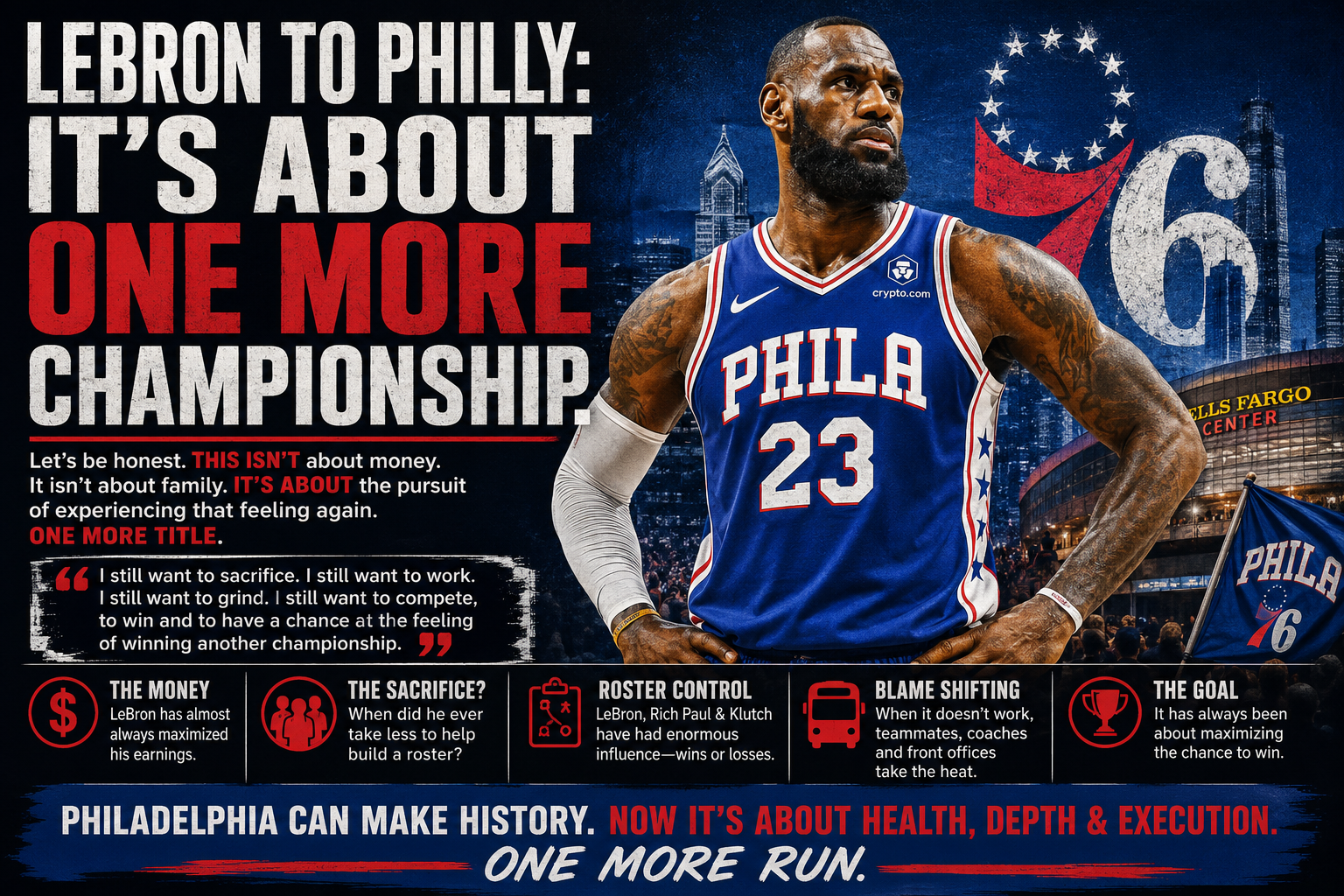
“I’m not going for money. I’m not going for family. What am I really playing for at this point?”
He then answered his own question by saying he still wants to sacrifice, compete, grind, and experience winning another championship.
Ironically, the last sentence was the only explanation he really needed.
Everything before it came across as unnecessary and, to many critics, disingenuous.
Just Say You Want Another Ring
There is absolutely nothing wrong with admitting you’re chasing another championship.
Michael Jordan chased championships.
Kobe Bryant chased championships.
Tim Duncan chased championships.
Stephen Curry is still chasing championships.
Every all-time great wants to win.
There is no shame in saying:
“I believe Philadelphia gives me the best opportunity to win another title.”
That would have been authentic.
Instead, bringing up money and family almost creates a false narrative that those were legitimate options being sacrificed.
At this point in LeBron’s career, no one believes he is making basketball decisions because he needs another paycheck.
No one believes he is suddenly leaving his family behind.
Those points distract from the obvious reality.
He wants another championship before he retires.
That’s perfectly understandable.
This Isn’t New
LeBron has always made career decisions based on maximizing his championship window.
He left Cleveland for Miami because the Heat gave him a better opportunity to win.
He returned to Cleveland when Kyrie Irving, assets, and a young roster made another championship possible.
He joined the Lakers when they could eventually pair him with another superstar.
Now he’s in Philadelphia because Joel Embiid, Tyrese Maxey, and a talented roster provide another legitimate opportunity.
This isn’t criticism.
It’s simply recognizing a consistent pattern.
The Timing Says Everything
What happened in New York this season likely played a role.
The Knicks reminded the NBA what championship basketball looks like inside Madison Square Garden.
The energy.
The atmosphere.
The city.
The national attention.
For any veteran chasing one last defining moment, that environment is attractive.
Had New York not completely reshaped its roster by acquiring Giannis Antetokounmpo, many people would likely be wondering whether Madison Square Garden, not Philadelphia, would have become LeBron’s final destination.
Instead, Philadelphia emerged as the best available opportunity.
The “Sacrifice” Argument Doesn’t Match History
Perhaps the most questionable part of LeBron’s statement is the idea that he is still sacrificing.
Sacrifice usually involves giving something up.
Financially, that has rarely been the case throughout LeBron’s career.
Outside of his move to Miami in 2010, LeBron has almost always maximized his earnings.
When he joined the Heat, he accepted a smaller contract than he could have demanded so Miami could sign Chris Bosh, retain Dwyane Wade, and preserve flexibility to build a championship roster.
That decision deserves credit.
But after leaving Miami, that became the exception rather than the rule.
During his second stint in Cleveland, LeBron repeatedly signed shorter contracts and maximized every available dollar.
With the Lakers, he consistently opted into or negotiated contracts that paid him at or near the maximum salary.
Nothing is wrong with earning every dollar available.
NBA players should maximize their value.
But it becomes difficult to argue you’re sacrificing financially when your contract decisions have consistently prioritized maximum compensation.
If creating roster flexibility was truly the highest priority, there were opportunities over the past several seasons to accept less money and give the Lakers additional flexibility around Anthony Davis.
The same argument applied after Luka Dončić arrived. Additional financial flexibility could have created more options for building depth around two elite stars.
Instead, the Lakers continued operating under the financial limitations created by maximum salaries.
Again, there is nothing wrong with that choice.
Players earn what the market allows.
But those choices should be acknowledged honestly.
The Lakers Weren’t the Only Ones Making Decisions
Another reality often ignored is how much influence LeBron James, Rich Paul, and Klutch Sports have wielded throughout his career.
Both Cleveland and Los Angeles routinely structured their organizations around LeBron’s preferences.
Roster moves.
Coaching decisions.
Veteran signings.
Player acquisitions.
Many of those decisions reflected the priorities of LeBron’s inner circle.
When moves succeeded, LeBron received much of the credit.
When they failed, criticism frequently shifted toward teammates, coaches, front offices, or ownership.
Whether fair or not, that pattern has followed LeBron for years.
The organizations often absorbed the blame while the influence of Klutch Sports over personnel decisions received far less scrutiny.
Philadelphia Is Taking a Gamble
Despite the criticism, Philadelphia’s gamble makes basketball sense.
If Joel Embiid remains healthy.
If Tyrese Maxey continues ascending.
If LeBron can still perform at an All-NBA level despite his age.
If the 76ers build a reliable bench capable of surviving playoff rotations.
Then Philadelphia immediately enters the championship conversation.
Those are significant “ifs.”
Health has been Philadelphia’s biggest obstacle for years.
Depth has also been inconsistent.
Winning a championship requires far more than assembling star power.
It requires durability, chemistry, coaching, defense, role players, and timely contributions from every part of the roster.
History Is Still Available
If Philadelphia gets everything right, history could be made.
LeBron could capture another championship with a fourth franchise.
That accomplishment would further distinguish an already remarkable career and strengthen one of the greatest résumés in NBA history.
It would also give Philadelphia its first NBA championship since 1983 and instantly become one of the biggest moments in franchise history.
That possibility is real.
But it starts with honesty.
LeBron did not need to explain that it wasn’t about money.
He didn’t need to mention family.
He didn’t need to frame the decision as some deeper personal sacrifice.
The simplest explanation was always the most believable.
He wants one more championship.
Philadelphia gives him the best chance to chase it.
There is nothing wrong with saying exactly that.