There are blockbuster sports transactions, and then there are transactions that should make regulators, players, fans and taxpayers stop what they are doing and start asking questions.
The proposed $12.5 billion sale of the Los Angeles Lakers belongs in the second category.
This is not merely another billionaire buying another professional sports franchise.
This is the Lakers.
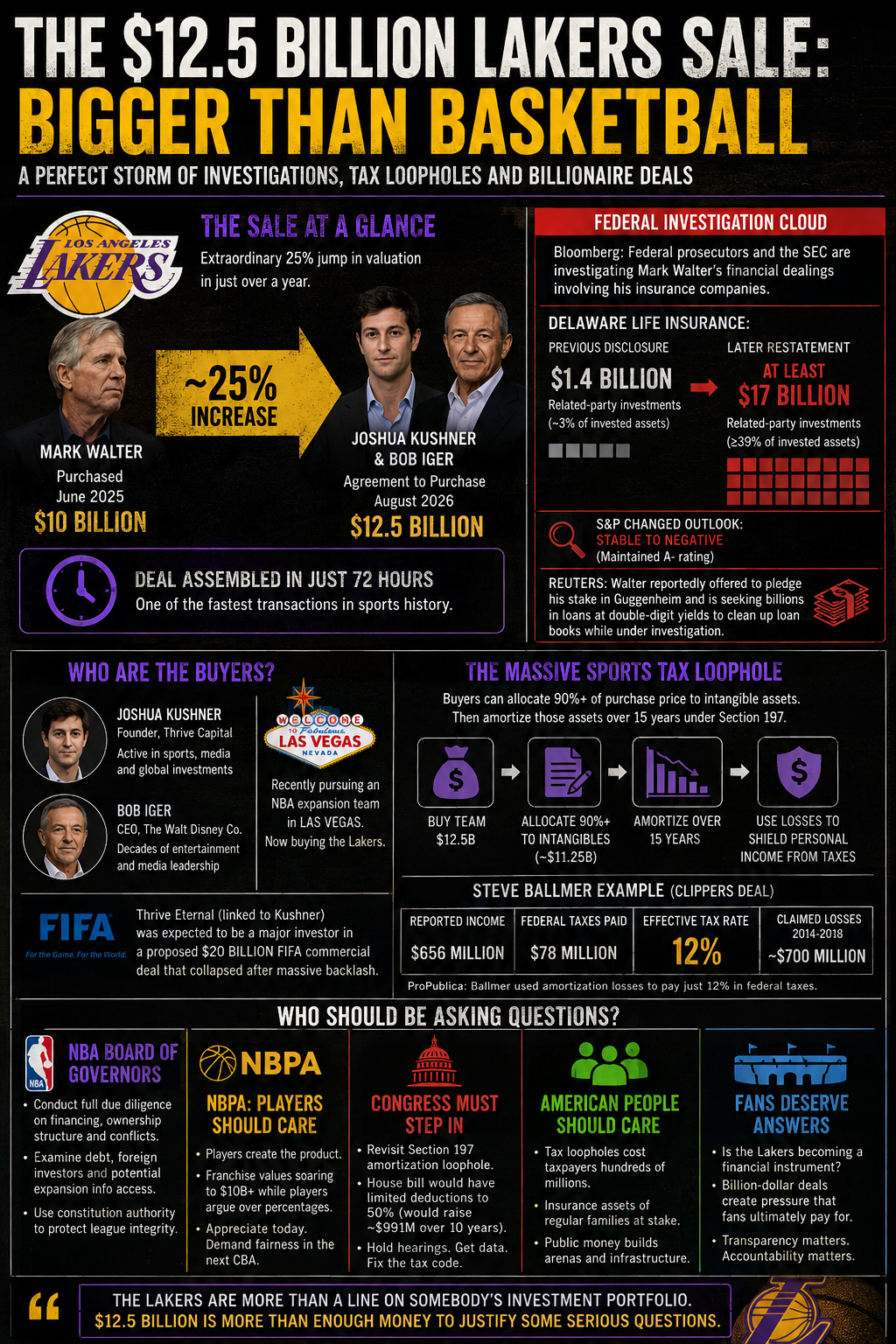
It is a franchise with 17 NBA championships, generations of fans, enormous cultural influence and a brand that extends far beyond basketball. And now, barely more than a year after Mark Walter acquired control of the Lakers at a reported $10 billion valuation, Walter has agreed to sell the franchise to an investment group led by Joshua Kushner and Bob Iger at a reported $12.5 billion valuation. Reuters reports that the transaction still requires NBA Board of Governors approval and due diligence. (Reuters)
That means this deal is not finished.
And the NBA should not treat its approval as a formality.
Not with Walter’s broader financial empire under federal scrutiny.
Not with questions surrounding billions of dollars of affiliated investments held by insurance companies connected to Walter.
Not when the proposed buyers were recently pursuing an NBA expansion opportunity in Las Vegas.
Not after a Kushner-linked investment vehicle became involved in a controversial proposal involving billions of dollars and FIFA’s commercial assets.
And certainly not when America’s tax code can transform the purchase of a professional sports franchise into an extraordinary tax-planning vehicle for some of the wealthiest people in the country.
This is where basketball becomes a matter of corporate governance, tax policy and public accountability.
The Numbers Alone Demand Attention
Start with the basic economics.
Walter acquired control of the Lakers in 2025 in a transaction valuing the organization around $10 billion.
Now the franchise is being sold at $12.5 billion.
That is roughly a $2.5 billion increase in valuation, or approximately 25 percent, in little more than a year.
A $2.5 billion increase is greater than what Steve Ballmer paid for the entire Los Angeles Clippers franchise in 2014.
That does not automatically make anything improper.
Professional sports franchises have appreciated enormously, and the Lakers are arguably one of the world’s premier sports properties.
But context matters.
Walter’s sale comes while parts of his financial empire are under federal investigation.
Bloomberg reported in July that federal prosecutors were examining potential financial improprieties involving Walter’s insurance companies and Guggenheim Partners. The investigation reportedly involves Delaware Life Insurance and Clear Spring Life and Annuity and is occurring alongside scrutiny from the Securities and Exchange Commission. (Bloomberg Law News)
That distinction is important.
An investigation is not a conviction.
Allegations are not proof of wrongdoing.
Walter and companies associated with him are entitled to the presumption that no wrongdoing occurred unless evidence establishes otherwise.
But the existence of an investigation involving billions of dollars and businesses connected to the owner of one of America’s most valuable sports franchises is unquestionably relevant when that owner suddenly decides to sell that franchise.
The Insurance Numbers Are Stunning
The financial disclosures deserve particular attention.
Bloomberg reported that Delaware Life previously disclosed approximately $1.4 billion, or about 3 percent of its invested assets, as related-party investments. Subsequent disclosures increased related-party investments to at least $17 billion, representing at least 39 percent of invested assets. (Archive.is)
Reuters Breakingviews separately reported that Delaware Life classified approximately $16 billion, or 37 percent of invested assets, as affiliated investments following an internal review. Federal prosecutors and the SEC are examining whether financial relationships involving Walter-controlled or affiliated entities were adequately disclosed. Reuters emphasized that there was no established evidence of wrongdoing by Walter at the time of its report. (Reuters)
That is the kind of discrepancy that should make regulators pay attention.
And apparently they are.
S&P also changed Delaware Life’s outlook from stable to negative following the disclosures, although it maintained the insurer’s A- financial-strength rating. (Archive.is)
This matters beyond Mark Walter.
Life insurance companies and annuity providers hold money associated with ordinary people’s financial security.
Policyholders are not billionaire venture capitalists.
They are families buying protection against death. They are retirees purchasing annuities. They are workers attempting to create financial stability.
That makes transparency surrounding affiliated investments extraordinarily important.
Then Came the Need for Capital
The story became even more significant after the Lakers agreement.
Reuters reported Thursday that Walter offered to pledge his equity stake in Guggenheim Partners while seeking billions of dollars for his insurance companies. According to the report, the capital-raising effort included offering investors double-digit yields through TWG Global. Reuters said the effort was connected to plans to clean up loan books at Delaware Life and Clear Spring while those companies remained under federal investigation. (Reuters)
Now put the timeline together.
Federal scrutiny.
Massive revisions involving affiliated investments.
Efforts to raise billions.
An offer to pledge Guggenheim equity.
Double-digit yields being discussed.
And a $12.5 billion Lakers transaction assembled with extraordinary speed.
The Wall Street Journal reported that Walter’s need for liquidity played a role in his willingness to sell and that the Lakers transaction materialized rapidly after Kushner and Iger shifted their attention from NBA expansion toward buying the existing franchise. (The Wall Street Journal)
None of this proves the Lakers transaction is improper.
It does, however, justify asking why it happened, how it happened and whether every party involved has been subjected to appropriate scrutiny.
That is what responsible governance requires.
The NBA Board of Governors Cannot Rubber-Stamp This Deal
NBA Commissioner Adam Silver and the league’s Board of Governors have an obligation that goes far beyond determining whether Kushner and Iger can write the checks.
The NBA’s own Constitution gives the league enormous investigative authority over ownership transfers.
Under Article 5, the Commissioner can demand information concerning a proposed transfer, prospective owners, associated entities and other matters considered relevant. The Commissioner then conducts an investigation before submitting the transaction for approval. A transfer generally requires approval from at least three-fourths of the NBA’s governors. (NBA)
The league’s Constitution also explicitly gives the Board of Governors authority to establish limits on the indebtedness and other obligations that teams and owners may incur. (NBA)
Use that authority.
The NBA should independently examine the financing structure behind this acquisition.
Who exactly owns what percentage?
How much debt is financing the transaction?
What entities ultimately provide the capital?
Are there foreign investors?
Are there sovereign interests?
Are there undisclosed side agreements?
Are there conflicts involving other sports investments?
What happens if investors need liquidity?
What protections prevent the Lakers from becoming collateral for unrelated financial ventures?
And what happens when institutional investors eventually want their money back?
Those are not anti-business questions.
They are basic governance questions involving a $12.5 billion institution.
Then There Is Las Vegas
There is another issue the NBA cannot simply ignore.
Before purchasing the Lakers, Kushner and Iger reportedly had been exploring ownership of a potential NBA expansion franchise.
In Las Vegas.
That matters because the NBA is actively considering expansion.
In March, the NBA Board of Governors officially authorized the league to explore expansion into Las Vegas and Seattle. The NBA hired PJT Partners to examine potential markets, ownership groups, arena infrastructure and financial considerations. (NBA.com)
Commissioner Silver has said the league hopes to decide by the end of 2026 whether expansion will proceed. He has also acknowledged that the league could add two teams, one team or none. (NBA.com)
Now one potential expansion ownership group is buying the Lakers instead.
That creates legitimate questions.
What information did prospective Las Vegas investors receive during the expansion process?
What financial projections were discussed?
What confidential league information became available?
Could any information obtained while pursuing expansion have influenced the valuation or purchase of the Lakers?
Did the NBA maintain appropriate firewalls?
Were other potential Lakers purchasers given an opportunity to bid?
Did the speed of the transaction prevent a broader competitive process that could theoretically have produced an even higher price?
Again, asking questions is not alleging wrongdoing.
It is what competent institutions do before approving one of the largest ownership transactions in sports history.
The FIFA Connection Deserves Scrutiny Too
Kushner’s investment activities also deserve examination.
Thrive Eternal, an investment vehicle associated with Kushner, was expected to become a major investor in a proposed FIFA commercial enterprise.
The proposal contemplated outside investors purchasing as much as 20 percent of a new FIFA commercial entity valued around $20 billion. The plan sought approximately $4.2 billion in outside investment and would have placed broadcasting, sponsorship and tournament-related assets into the venture. (Axios)
The proposal eventually collapsed amid extraordinary opposition.
Reuters reported that FIFA abandoned the plan after intense criticism from soccer officials and internal opposition. (Reuters)
That does not disqualify Kushner from NBA ownership.
But it gives the NBA another reason to examine the philosophy behind the investment vehicle purchasing the Lakers.
Is the Lakers organization being acquired primarily as a basketball institution?
Or is it becoming another permanent-capital asset inside an investment portfolio built around scarce sports and cultural properties?
Those objectives are not necessarily incompatible.
But fans, players and the league deserve to know.
The NBPA Should Be Paying Attention
The National Basketball Players Association should not sit on the sidelines.
The current collective bargaining agreement governs the economic relationship between players and owners through the 2029-30 season, with opt-out provisions after the 2028-29 season. (NBPA.com)
Players generate the product.
Without players, there are no television contracts.
No jersey sales.
No sold-out arenas.
No sponsorship agreements.
No billion-dollar franchise valuations.
And certainly no $12.5 billion Lakers transaction.
Yet professional sports increasingly operate under a strange economic contradiction.
Owners can argue during collective bargaining that expenses are rising and economic limitations are necessary while their franchises appreciate by billions of dollars.
The Lakers valuation illustrates the point dramatically.
A franchise valued around $10 billion in 2025 is now the subject of a $12.5 billion transaction.
That appreciation should matter in future conversations about basketball-related income, salary-cap structures, revenue sharing and the overall economics of NBA ownership.
Players should be asking whether the current system adequately recognizes the wealth being generated by franchise appreciation.
And Then We Reach the Tax Code
This may be the part that should anger ordinary Americans the most.
Professional sports owners can receive enormous tax benefits after purchasing franchises because federal tax law generally permits purchasers to amortize qualifying intangible assets over 15 years under Section 197.
These assets can include goodwill and other intangible property associated with the acquired business.
Professional sports franchises are particularly interesting because enormous portions of their purchase prices can be associated with intangible assets.
The consequences can be staggering.
ProPublica examined Steve Ballmer’s finances after he purchased the Clippers for $2 billion.
Ballmer reported $656 million in income during one year examined by ProPublica while paying $78 million in federal income taxes.
Effective rate: approximately 12 percent.
ProPublica also reported that between 2014 and 2018 Ballmer claimed approximately $700 million in losses connected with Clippers ownership, with much of those losses likely attributable to amortization. (ProPublica)
Think about that.
A sports franchise can dramatically appreciate economically while simultaneously producing tax deductions because intangible assets are treated as declining for tax purposes.
The Clippers became vastly more valuable.
Yet tax accounting could still generate enormous paper losses.
That deserves congressional scrutiny.
Congress Already Tried to Change It
What makes the Lakers transaction even more timely is that Congress recently considered limiting this advantage.
A House version of President Trump’s major tax legislation contained a provision that would have limited amortization of certain professional sports franchise intangible assets to 50 percent of adjusted basis rather than 100 percent.
The Bipartisan Policy Center estimated the provision would have raised approximately $991 million in federal revenue over the 2025-2034 period. (Bipartisan Policy Center)
Congressional legislative text confirms the proposed change.
Section 112017 specifically covered franchises involving professional football, basketball, baseball, hockey, soccer and other professional sports and would have substituted 50 percent of adjusted basis for the full adjusted basis in applying the amortization provision. (Congress.gov)
That proposal did not become the governing limitation described in the final law.
Congress should revisit it.
Not because wealthy people should be punished for buying sports teams.
Because the tax code should make economic sense.
A delivery company’s trucks actually depreciate.
Factory equipment wears out.
Computers become obsolete.
Machinery eventually requires replacement.
But what exactly is depreciating about membership in the NBA?
The Lakers brand?
The right to participate in the league?
The league’s national media rights?
The franchise itself?
The evidence points in the opposite direction.
The Lakers’ reported valuation went from approximately $10 billion to $12.5 billion in barely more than a year.
That is appreciation.
Not depreciation.
Congress Should Hold Hearings
Congress does not need to determine whether someone should own the Lakers.
That belongs principally to the NBA.
Congress does have jurisdiction over federal taxation, securities regulation, interstate commerce and financial regulation.
That provides plenty to examine.
Congress should hold public hearings on the tax treatment of professional sports ownership.
The House Ways and Means Committee and Senate Finance Committee should examine Section 197 amortization.
The appropriate financial-services committees should examine the increasing intersection between private credit, insurance assets and professional sports ownership.
Lawmakers should ask whether existing disclosure requirements are adequate when individuals controlling insurance companies simultaneously build multibillion-dollar sports portfolios.
Congress should also request data from the Treasury Department and IRS showing how much revenue the federal government loses annually through sports-franchise amortization.
Americans deserve to know.
Fans Should Care Because Eventually Somebody Pays
There is a temptation to dismiss all of this by saying:
It is billionaire money.
Who cares?
Fans should.
Because a $12.5 billion purchase price eventually creates economic expectations.
Investors want returns.
Debt requires servicing.
Capital expects appreciation.
And franchises generate revenue through fans.
Tickets.
Parking.
Concessions.
Luxury suites.
Merchandise.
Streaming packages.
Television contracts.
Sponsorships.
Arena agreements.
Public infrastructure.
Every record-setting acquisition increases pressure somewhere in the system to generate more money.
The people who love the Lakers should therefore have every right to ask whether their basketball team is becoming primarily a financial instrument.
Sports Teams Are Not Ordinary Assets
That is the larger conversation America needs to have.
Professional franchises may be privately owned businesses, but they occupy a unique position in American society.
Cities identify with them.
Families pass fandom across generations.
Taxpayers frequently subsidize arenas and surrounding infrastructure.
Local governments make economic-development decisions around them.
Television networks build programming around them.
Workers depend on them.
Players build their careers inside them.
And fans provide the emotional loyalty that ultimately creates their enormous valuations.
Yet when these franchises change hands, the public frequently has almost no meaningful role.
One billionaire sells.
Another billionaire buys.
Investment bankers get paid.
Lawyers finalize documents.
Tax specialists structure the transaction.
The league votes.
Fans get a press release.
That model deserves examination.
The NBA Should Slow Down
There is no compelling reason for the NBA Board of Governors to rush this transaction.
The Lakers are not some distressed small business requiring an emergency buyer.
They are one of the most valuable sports organizations on Earth.
The league should conduct exhaustive due diligence.
The Board should require complete disclosure of the ownership structure.
It should understand every major source of financing.
It should examine potential conflicts created through Thrive’s other sports investments.
It should examine what information Kushner and Iger received during their exploration of Las Vegas expansion.
It should understand Walter’s financial circumstances and whether they influenced the sale.
And it should coordinate appropriately with regulators where legal questions overlap.
Only then should the governors vote.
Because the question is bigger than whether Joshua Kushner and Bob Iger have enough money to purchase the Lakers.
The question is whether the NBA’s ownership system is prepared for an era in which franchises worth more than $10 billion are becoming sophisticated financial assets traded among investment vehicles, billionaires and institutional capital.
Basketball Cannot Become Just Another Billionaire Tax Shelter
There is something fundamentally uncomfortable about an economic system in which the worker selling concessions can have taxes withheld from every paycheck while a billionaire can purchase a professional sports franchise and potentially generate enormous paper deductions from assets simultaneously becoming more valuable.
That is not an argument against wealth.
It is an argument for consistency.
If the Lakers are worth $12.5 billion, then say they are worth $12.5 billion.
If their brand is appreciating, acknowledge that reality.
If NBA membership is extraordinarily valuable, stop pretending for tax purposes that everything associated with owning that membership behaves like machinery deteriorating inside a factory.
And if professional sports franchises have become one of America’s greatest stores of wealth, Congress should update the tax code to reflect what these assets have actually become.
The Lakers sale gives America the perfect case study.
Federal investigators should finish their work concerning Walter’s businesses without political interference.
The NBA should conduct independent and aggressive due diligence before approving the transaction.
The NBPA should examine what rapidly appreciating franchise values mean for players in the next collective bargaining negotiations.
Congress should revisit sports-franchise amortization.
And fans should stop accepting the idea that because billionaires are buying teams, billionaire finances are none of their business.
They become our business when tax laws are involved.
They become our business when insurance companies holding people’s retirement and life-insurance assets are involved.
They become our business when public infrastructure supports professional sports.
And they become the NBA’s business when the integrity and stability of a franchise are involved.
The $12.5 billion Lakers sale might ultimately prove completely legitimate and financially sound.
If so, rigorous scrutiny will demonstrate that.
But when a legendary franchise changes hands barely more than a year after a $10 billion transaction, while the seller’s broader financial empire is under federal scrutiny, the buyers have recently participated in other massive sports-investment efforts, the league is simultaneously evaluating multibillion-dollar expansion opportunities and federal tax law potentially provides enormous benefits to the new owners, nobody should be offended by questions.
We should be offended if nobody asks them.
The NBA does not need another rubber stamp.
Congress does not need another excuse for inaction.
And American taxpayers should not continue watching billionaires purchase appreciating sports empires while the tax code allows accounting treatments unavailable to virtually everyone sitting in the stands.
Basketball may be a business.
But the Lakers are more than a line on somebody’s investment portfolio.
And $12.5 billion is more than enough money to justify some serious damn questions.