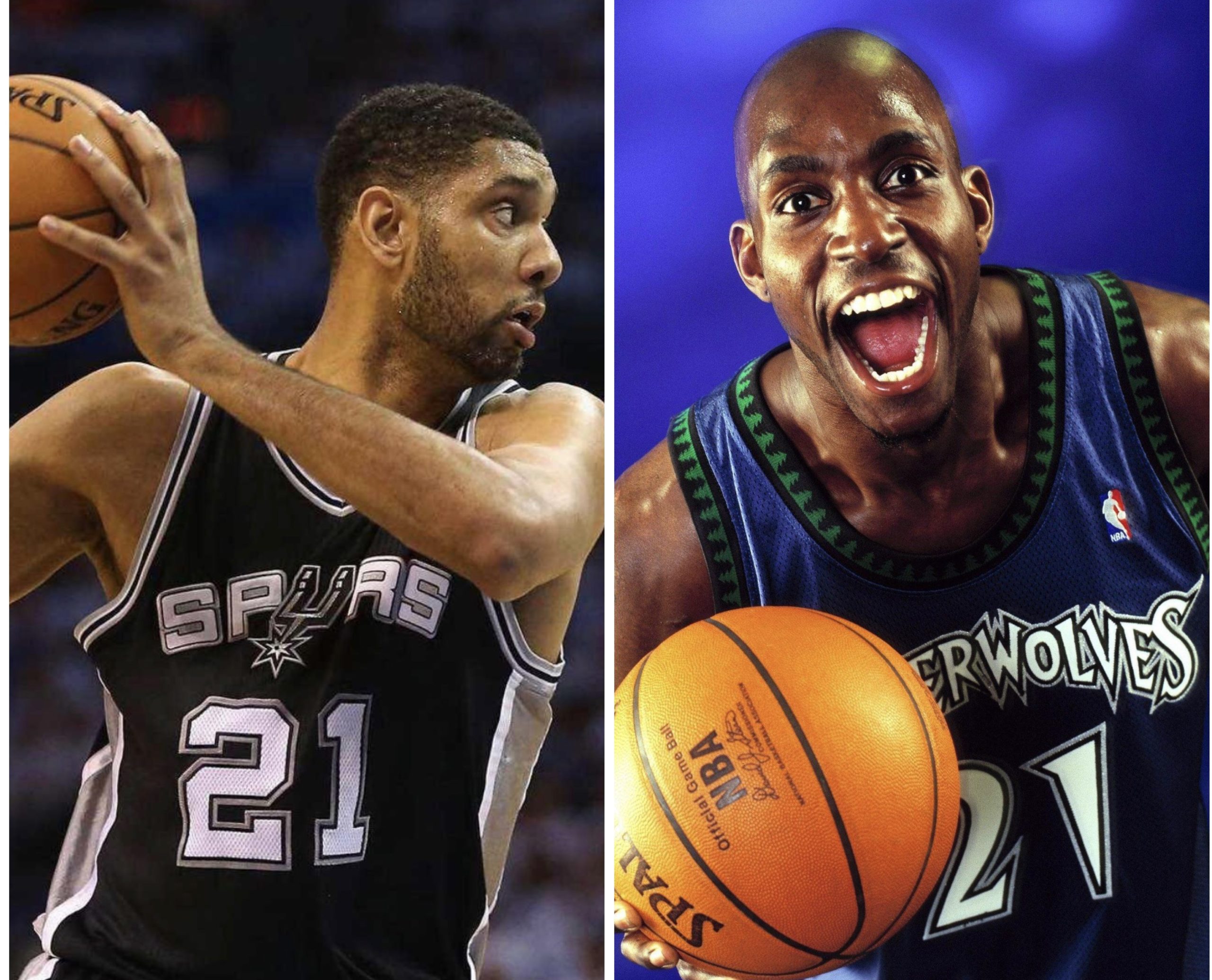
The debate over the greatest power forward in NBA history has a familiar name at the top: Tim Duncan.
Five NBA championships, three Finals MVP awards and two regular-season MVPs have made Duncan the standard by which other power forwards are measured. But Tracy McGrady is challenging whether Duncan’s place at the top is based entirely on individual greatness or whether his circumstances and championship success have helped shape the conversation. At at at
During a discussion on the Cousins Podcast, McGrady made the case that Kevin Garnett was arguably the better basketball player, suggesting that Duncan’s five championship rings have played a significant role in how the two legends are viewed historically.
It’s an argument that deserves more attention than a simple comparison of championship totals.
Kevin Garnett’s Individual Case
Garnett was one of the most versatile big men of his generation. At 6-foot-11, he combined an elite defensive presence with the ability to score, rebound, facilitate and impact nearly every area of the game.
His 2003-04 campaign remains one of the strongest individual seasons by a power forward in NBA history.
Playing for the Minnesota Timberwolves, Garnett averaged 24.2 points, 13.9 rebounds, 5.0 assists, 1.5 steals and 2.2 blocks per game. He earned league MVP honors after leading Minnesota to a 58-win season and the Western Conference Finals.
Garnett was more than a scorer. His defensive versatility allowed him to protect the rim, defend away from the basket and disrupt opposing offenses. He could operate in the post, face up from the perimeter and create opportunities for teammates.
He eventually captured his only NBA championship with the Boston Celtics in 2008, alongside Paul Pierce and Ray Allen.
The question is whether Garnett’s championship total accurately reflects his individual impact throughout his career.
Tim Duncan’s Championship Pedigree
Duncan’s argument is difficult to dismiss.
The San Antonio Spurs selected him first overall in the 1997 NBA Draft, and he quickly became the centerpiece of one of the most successful franchises in professional sports.
Duncan won championships in 1999, 2003, 2005, 2007 and 2014. He earned Finals MVP honors three times and won consecutive regular-season MVP awards in 2002 and 2003.
His résumé also includes 15 All-NBA selections and 15 All-Defensive Team selections.
However, Duncan’s greatness wasn’t simply a product of playing for a successful organization.
He was the foundation of that success.
His partnership with Gregg Popovich, along with the contributions of David Robinson, Tony Parker, Manu Ginóbili and Kawhi Leonard at different stages of his career, helped San Antonio sustain a championship culture for nearly two decades.
Duncan’s ability to anchor a defense, score efficiently, control the boards and deliver in the postseason made him the ideal centerpiece for that system.
He wasn’t just along for the ride. He was driving it.
How Much Should Championships Matter?
This is where McGrady’s argument becomes particularly interesting.
NBA history is filled with elite players whose individual accomplishments didn’t always translate into championships. Team construction, coaching, front-office decisions, injuries and timing all influence a player’s opportunity to win.
Garnett spent 12 seasons as Minnesota’s marquee player before joining Boston. Although he delivered an MVP season and helped the Timberwolves reach the Western Conference Finals, the franchise struggled to consistently surround him with championship-caliber talent.
Duncan, meanwhile, benefited from remarkable organizational stability in San Antonio.
That doesn’t diminish Duncan’s accomplishments. It does raise a legitimate question about how much circumstances influence the way we evaluate individual players.
If Garnett had spent his prime years in San Antonio, would his championship résumé look different?
And if Duncan had spent his career in Minnesota, would the historical conversation surrounding him be the same?
Those are impossible questions to answer, but they’re worth considering when comparing two players with such different career experiences.
The Verdict: Duncan’s Legacy vs. Garnett’s Versatility
There’s a strong argument that Garnett was the more versatile player. His combination of athleticism, defensive range, passing ability and offensive skill made him one of the most complete big men of his era.
But versatility alone doesn’t settle the debate.
Duncan’s consistency, postseason production, leadership and ability to anchor championship teams give him an incredibly strong case as the greatest power forward ever.
Although Duncan is largely considered the greatest power forward of all time, Garnett deserves to be part of the conversation, and the gap between their individual abilities may be smaller than the championship count suggests.
McGrady has reopened a debate that basketball fans will probably never completely settle.
So, who was actually the better power forward: Tim Duncan or Kevin Garnett?
We want to hear your argument.