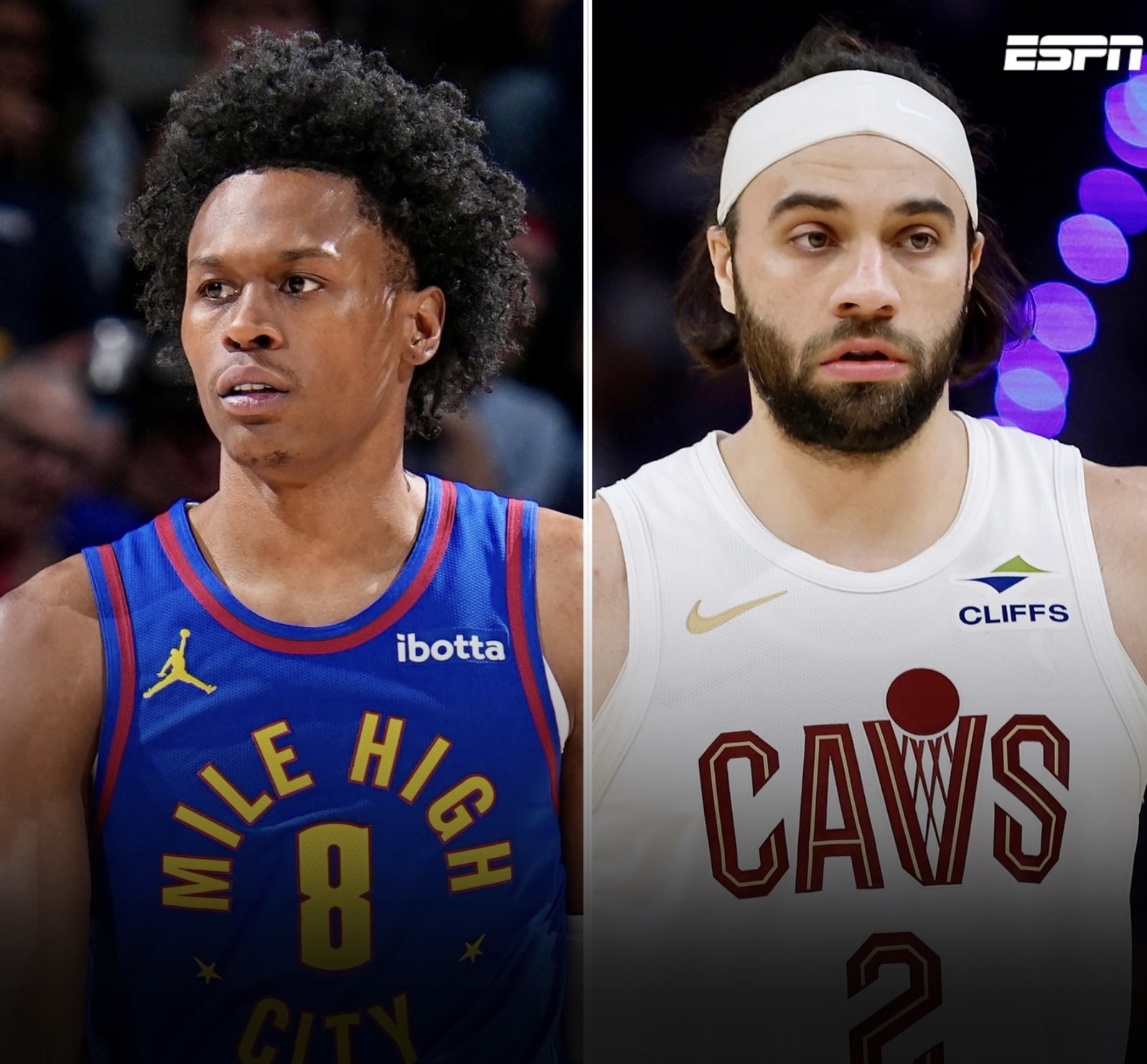
Image via ESPN
The Cleveland Cavaliers are making a major investment in their future.
Cleveland, the Denver Nuggets and Los Angeles Clippers have agreed to a three-team trade that will send Peyton Watson to the Cavaliers, Max Strus to the Clippers, and future draft capital to the Nuggets, according to ESPN and other media outlets.
As part of the deal, Watson is expected to sign a new four-year, $88 million contract with Cleveland that includes a player option and trade kicker. (Hoops Wire)
The Nuggets will receive Cleveland’s unprotected 2031 first-round pick and a 2032 second-round pick from the Sacramento Kings.
For Cleveland, the deal represents a significant commitment to a young two-way wing coming off the best statistical season of his career.
Cleveland Bets Big on Peyton Watson
Watson, 23, broke out for Denver during the 2025-26 season, averaging 14.6 points, 4.9 rebounds and 2.1 assists in 54 games while playing 29.6 minutes per night.
He also provided impressive defensive production, averaging 0.9 steals and 1.1 blocks per game.
Perhaps most importantly for Cleveland, Watson showed that his offensive game has developed alongside his defensive versatility.
He shot 49.1% from the field and 41.1% from three-point range during the season, giving the Cavaliers a player who can provide athleticism and defensive length without sacrificing perimeter shooting.
Watson’s 2025-26 numbers:
| Category | |
| Games | 54 |
| Minutes | 29.6 |
| Points | 14.6 |
| Rebounds | 4.9 |
| Assists | 2.1 |
| Steals | 0.9 |
| Blocks | 1.1 |
| FG% | 49.1% |
| 3PT% | 41.1% |
| FT% | 73.0% |
| Plus/Minus | +3.6 |
That production helps explain why Cleveland was willing to make a significant financial commitment to Watson.
The Cavaliers had been pursuing Watson as a potential answer on the wing, and the move gives them a younger, more athletic option with defensive versatility. Cleveland’s pursuit of Watson had been reported for weeks before Wednesday’s agreement.
Clippers Add Max Strus
Los Angeles will acquire Strus, adding a veteran perimeter shooter and experienced rotation player.
Strus appeared in only 12 games during the 2025-26 regular season, but averaged 11.2 points, 5.4 rebounds and 2.0 assists in 24.0 minutes per game.
He shot 44.3% from the field and 40.2% from three-point range.
Strus’ 2025-26 numbers:
| Category | |
| Games | 12 |
| Minutes | 24.0 |
| Points | 11.2 |
| Rebounds | 5.4 |
| Assists | 2.0 |
| Steals | 0.2 |
| Blocks | 0.0 |
| FG% | 44.3% |
| 3PT% | 40.2% |
| FT% | 77.8% |
The small sample size is important context. Strus missed most of the season after undergoing surgery to repair a Jones fracture in his left foot before returning in March. (Wikipedia)
Still, his shooting remains one of his biggest strengths.
The Clippers are essentially betting that a healthy Strus can provide reliable spacing, perimeter shooting and veteran experience.
Watson vs. Strus: What Cleveland Is Changing
The statistical comparison illustrates the direction Cleveland is taking.
Watson averaged 3.4 more points per game than Strus last season while playing nearly six additional minutes per game. He also produced considerably more defensive impact, averaging 0.9 steals and 1.1 blocks compared with Strus’ 0.2 steals and zero blocks.
At the same time, Strus actually averaged slightly more rebounds, 5.4 to 4.9, despite his smaller role and limited sample.
And while Strus has established himself as a dependable shooter, Watson actually shot slightly better from three last season — 41.1% compared with Strus’ 40.2%.
That makes the move particularly intriguing for Cleveland.
The Cavaliers aren’t simply replacing shooting with defense. They’re adding a younger player who demonstrated that he can contribute offensively while providing significantly more size, athleticism and defensive versatility.
Denver Turns Watson Into Future Assets
Denver’s return is centered on draft capital.
The Nuggets will receive Cleveland’s unprotected 2031 first-round pick, giving the franchise a potentially valuable long-term asset, along with a 2032 second-round selection originally belonging to Sacramento.
The trade also gives Denver financial flexibility after the organization was unable to reach a long-term agreement with Watson during restricted free agency. Reports indicated that Denver faced significant financial constraints under the NBA’s apron system. (Hoops Wire)
Rather than commit $88 million to Watson, Denver turns the situation into future draft capital.
That could prove especially valuable several years down the road when the Cavaliers’ roster and competitive outlook may look considerably different.
Why the Trade Makes Sense for All Three Teams
Cleveland: The Cavaliers get a young, athletic two-way wing who is coming off a breakout season and has four years of team investment ahead of him.
Los Angeles: The Clippers acquire an experienced shooter in Strus who can help space the floor and provide another veteran presence on the perimeter.
Denver: The Nuggets avoid making the financial commitment to Watson and instead add an unprotected future first-round pick plus a second-rounder.
From Cleveland’s perspective, however, the biggest story is the commitment to Watson.
The Cavaliers are betting that his 2025-26 season wasn’t a one-year spike, but the beginning of a much larger role.
If Watson continues to develop as a scorer while maintaining his defensive impact, the four-year, $88 million investment could eventually look like a bargain.
For now, Cleveland has made its decision: Watson is the player they believe is worth betting on.