By Hodari P.T. Brown
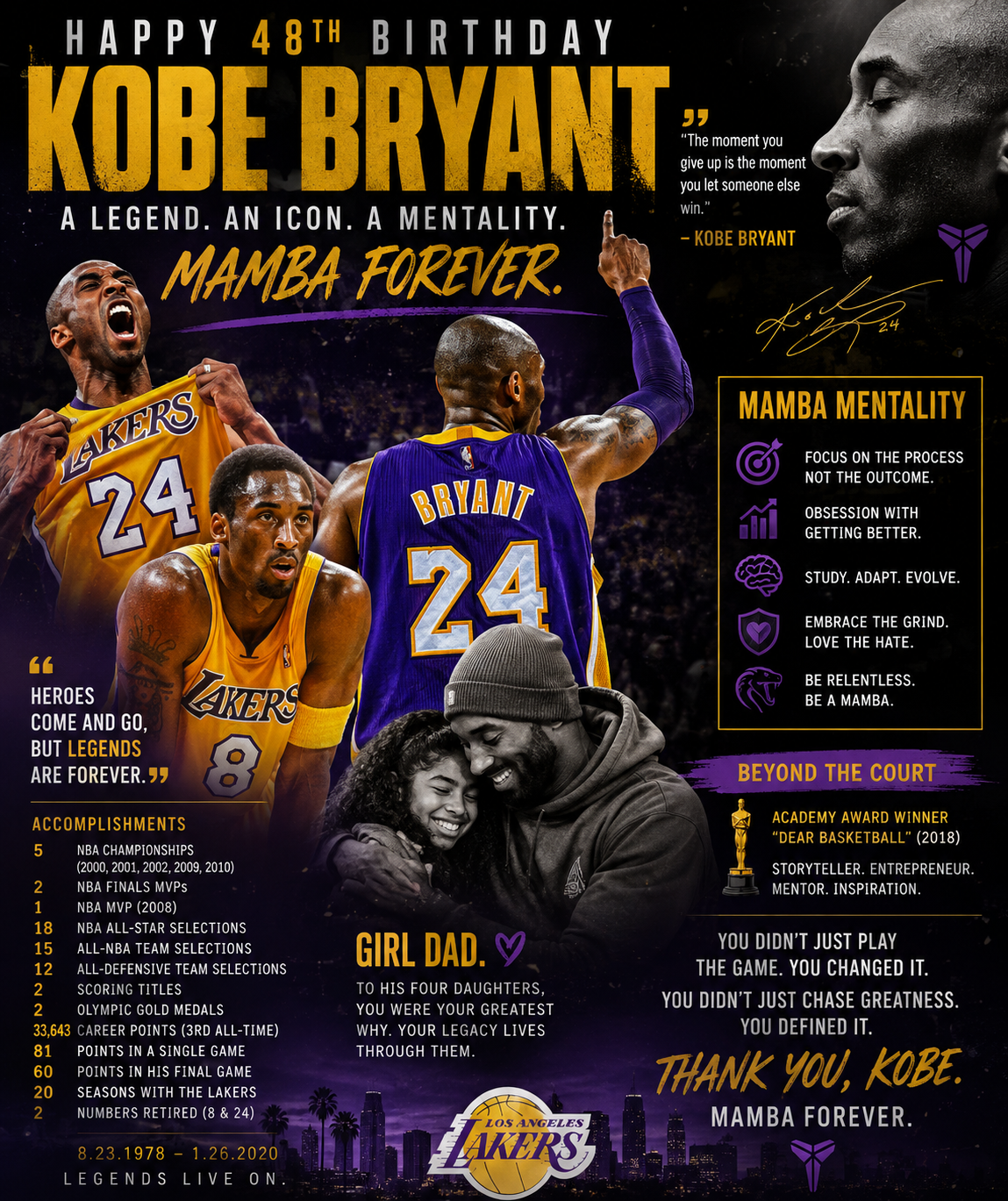
Kobe Bryant would have turned 48 years old on August 23, 2026.
That sentence still does not feel right.
There should be another chapter being written right now. Another film. Another book. Another business venture. Another coaching session with young players. Another courtside appearance with his daughters. Another interview where Kobe challenged somebody to think differently about preparation, discipline, storytelling, fatherhood or greatness.
Instead, we are left with memories.
But memory is exactly why Kobe Bryant’s 48th birthday should be more than another day of highlights on social media.
It should be an opportunity to protect his place in basketball history.
Because as the NBA moves further away from Kobe’s era, there seems to be a growing tendency to discuss him as though he were simply a Lakers legend instead of what he actually was:
One of the greatest basketball players who ever lived.
And when the conversation turns specifically to Michael Jordan, there is another truth worth defending.
Nobody came closer to giving basketball another Michael Jordan than Kobe Bryant.
Not because Kobe was Jordan.
He wasn’t.
Kobe was Kobe.
But the footwork, competitiveness, post game, midrange mastery, defensive intensity, obsession with preparation, appetite for pressure and willingness to take responsibility for the biggest shot made the comparison unavoidable.
Kobe did not run from it.
He studied greatness and then unapologetically pursued his own version of it.
The Résumé Is Too Great to Rewrite
Before debating feelings, generations or advanced statistics, look at what Kobe actually accomplished.
Five NBA championships.
Two NBA Finals MVP awards.
The 2008 NBA Most Valuable Player award.
Eighteen All-Star selections.
Fifteen All-NBA selections.
Twelve All-Defensive Team selections, including nine First Team selections.
Two NBA scoring championships.
Four All-Star Game MVP awards.
Two Olympic gold medals.
33,643 career regular-season points.
An 81-point game.
A 60-point final game.
Twenty seasons wearing one uniform.
Two jersey numbers retired by the same franchise.
And eventually, induction into the Naismith Memorial Basketball Hall of Fame.
The numbers are not mythology. They are documented history. (NBA)
That résumé does not belong merely in a discussion about great Lakers.
It belongs in the greatest-of-all-time conversation.
Kobe Was More Than a Scorer
One of the easiest ways to diminish Kobe historically is to reduce him to scoring.
Yes, Kobe could score.
He scored 81 points against Toronto in 2006, still the second-highest individual scoring performance in NBA history. He produced 25 career 50-point games and six 60-point performances. At retirement, his 33,643 points ranked third in NBA history. (NBA.com: NBA Communications)
But focusing exclusively on scoring ignores half of Kobe Bryant.
He made 12 All-Defensive teams.
Nine times he was First Team All-Defense. (NBA)
That matters when discussing all-time greatness.
Kobe wanted the responsibility of scoring 30 points, guarding the opposing team’s best perimeter player and then taking the final shot.
He did not want greatness selectively.
He wanted all of it.
The Closest Thing We Saw to Jordan
Michael Jordan remains the standard for many basketball fans, and saying Kobe came closest to Jordan does not require diminishing Jordan.
It recognizes Kobe.
Kobe studied Jordan’s movements almost like a scientist studying a formula.
The fadeaway.
The pivots.
The jab steps.
The footwork.
The turnaround jumper.
The defensive stance.
The psychological warfare.
The willingness to take difficult shots because he believed difficult circumstances revealed who had prepared properly.
Yet imitation alone could never have produced Kobe Bryant’s career.
Eventually the student developed his own identity.
Jordan became the blueprint.
Kobe turned that blueprint into the Mamba Mentality.
That distinction matters.
Mamba Mentality was not simply “work hard.” It represented an almost obsessive pursuit of improvement. Find your weakness. Attack it. Study your opponent. Study yourself. Prepare when nobody is watching. Become comfortable with discomfort.
Failure was information.
Pain was something to navigate.
Pressure was something to pursue.
That philosophy eventually became bigger than basketball.
When Winning Became Harder, Kobe Became More Dangerous
Kobe’s career was not one uninterrupted championship parade.
That is actually part of what makes his story compelling.
After winning three consecutive championships alongside Shaquille O’Neal from 2000 through 2002, the Lakers eventually entered a turbulent transition.
Shaq was traded.
Phil Jackson temporarily left.
The roster changed.
Kobe’s public image had changed dramatically.
The Lakers were no longer championship favorites.
Yet Kobe’s individual performance exploded.
During the 2005-06 season, he averaged 35.4 points per game. He won consecutive scoring titles in 2006 and 2007. (NBA)
That period matters when evaluating his legacy because Kobe could have looked elsewhere for an easier road.
Eventually, he became publicly frustrated.
In 2007, Bryant requested a trade amid concerns about the Lakers’ direction and whether management was sufficiently committed to building another championship team around him. Trade discussions involving Chicago and other teams became very real. (ESPN)
But Kobe never actually played for another franchise.
Twenty seasons.
One uniform.
Los Angeles Lakers.
Eventually the organization improved the roster, most importantly acquiring Pau Gasol.
Kobe responded with three consecutive NBA Finals appearances.
The Lakers lost to Boston in 2008.
They won the championship in 2009.
Then Kobe returned in 2010 and defeated Boston in a seven-game Finals series, earning his second consecutive Finals MVP.
Those championships changed the conversation.
Kobe had won without Shaq.
He had led a different Lakers team to the top.
Twice.
Imagine Kobe and Chris Paul
There is another fascinating chapter that should not disappear from Kobe’s story.
In December 2011, a proposed three-team transaction would have paired Kobe Bryant with Chris Paul.
Then-NBA Commissioner David Stern stopped the transaction while acting as the decision-maker for the league-owned New Orleans Hornets. The NBA maintained that the decision was made in the Hornets’ best interests. Paul was eventually traded to the Clippers instead. (ESPN)
History cannot tell us what would have happened.
We should not retroactively hand Kobe championships he never won.
But basketball fans are allowed to ask the question.
What would Kobe Bryant and Chris Paul have done together?
Paul was one of the greatest point guards of his generation. Kobe was still one of basketball’s premier competitors.
Could Kobe have won a sixth championship?
Could there have been a seventh?
Nobody knows.
But the possibility was real enough that even the Lakers later described Paul as someone expected to bolster Kobe’s chances of winning another championship. (NBA)
The partnership never happened.
Kobe kept playing.
That was what Kobe did.
The Achilles Moment Explained Kobe Better Than Any Speech Could
April 12, 2013.
Kobe tore his Achilles tendon against Golden State.
For most athletes, that moment immediately ends the night.
Kobe walked to the free-throw line.
He made both shots.
Then he left.
The Lakers themselves recount that Bryant remained on the floor long enough to sink those two free throws before exiting with what became one of the defining injuries of his career. (NBA)
That moment has become part of Mamba mythology, but underneath the mythology was something deeply human.
His body had finally told his mind no.
Kobe had spent his career believing preparation, willpower and discipline could push the body beyond ordinary limitations.
Eventually biology wins.
The Achilles injury was followed by additional injuries, and the final years became a battle against time.
But Kobe still found one final argument with Father Time.
April 13, 2016.
Final NBA game.
Age 37.
Sixty points.
Victory.
No player had ever scored more points in his final NBA game. (NBA.com: NBA Communications)
Of course Kobe Bryant walked away like that.
Mamba Mentality Did Not Retire
Then something remarkable happened.
Kobe proved basketball had never been the full extent of his imagination.
He became a storyteller.
A producer.
A filmmaker.
A mentor.
An author.
An entrepreneur.
His animated short “Dear Basketball,” based on the poem announcing his retirement, won the Academy Award for Best Animated Short Film in 2018. The Oscar officially went to Kobe Bryant and animator Glen Keane. (Oscars)
Think about the transition.
NBA champion to Academy Award winner.
Kobe approached storytelling the way he approached basketball: study the craft, surround yourself with talented people, learn relentlessly and compete seriously.
That may be one of the greatest lessons of his retirement.
Sometimes your first greatness does not have to become your last greatness.
Then Came “Girl Dad”
For all the championships, points, trophies and highlights, one of Kobe Bryant’s most enduring titles did not come from basketball.
Girl Dad.
Kobe was the father of four daughters: Natalia, Gianna, Bianka and Capri.
Watching his relationship with Gianna offered the public another view of him.
This was no longer simply the Black Mamba.
This was Dad.
Kobe spoke proudly about Gianna’s basketball ambitions and became an advocate for the women’s game. The image of Kobe sitting courtside with Gigi, explaining basketball while she absorbed every detail, became symbolic of something bigger.
The man who spent decades building his own basketball legacy was beginning to pour knowledge into the next generation.
Being called a “Girl Dad” softened nothing about Kobe’s greatness.
It expanded our understanding of it.
Strength was no longer only playing through injuries.
Strength was nurturing.
Strength was teaching.
Strength was showing up.
Strength was publicly celebrating daughters in a culture that still sometimes treats fathers as though sons are required to carry their legacy.
Kobe showed that legacy does not require a son bearing your name.
Kobe’s Story Was Not Without Serious Complications
Preserving Kobe Bryant’s legacy should not require pretending his life was without controversy or serious personal failures.
His public image changed dramatically following the 2003 sexual-assault case in Colorado. Criminal charges were eventually dismissed after the accuser declined to testify, while a separate civil case was later settled.
That episode remains part of his history.
Legacy should not mean erasing difficult chapters.
Human beings are complicated.
The meaningful question is whether we tell the whole story rather than converting people into either flawless heroes or permanent villains.
Kobe continued living under intense public scrutiny, rebuilt portions of his public life, continued performing at an extraordinary level and eventually entered a very different chapter centered increasingly around family, storytelling, mentoring and women’s basketball.
His legacy includes greatness, controversy, evolution, perseverance and consequence.
That complexity makes his story more human, not less important.
Do Not Let Basketball Forget Kobe Bryant
Every generation naturally elevates its own stars.
Today there are debates involving Jordan, LeBron James, Kareem Abdul-Jabbar, Magic Johnson, Larry Bird, Stephen Curry and players whose careers are still being written.
Those conversations are healthy.
But recency cannot become historical revisionism.
Kobe Bryant does not suddenly become less accomplished because another generation did not watch him play.
The game film remains.
The championships remain.
The defensive selections remain.
The scoring titles remain.
The 81 remains.
The five rings remain.
The two Finals MVPs remain.
The Olympic gold medals remain.
The 33,643 points remain.
The Oscar remains.
The Hall of Fame plaque remains.
Both Nos. 8 and 24 remain retired in Los Angeles — the only player in NBA history to have two numbers retired by the same franchise. (NBA)
And perhaps most symbolically, the NBA All-Star Game MVP trophy now bears Kobe Bryant’s name. (NBA)
That is not nostalgia.
That is history.
Forty-Eight Years After His Birth, Mamba Still Means Something
Kobe Bryant was born August 23, 1978. (NBA)
On what would have been his 48th birthday, perhaps the best way to honor him is not simply by replaying highlights.
Study the mentality.
Study the perseverance.
Study the contradictions.
Study the mistakes.
Study the evolution.
Study the willingness to reinvent himself.
Study the father.
Study the filmmaker.
Study the competitor.
Study the man who could lose, hurt, fail, become unpopular, demand more, be criticized, get injured and still believe another level existed.
That is why Mamba Mentality survived Kobe Bryant.
It was never really about making impossible jump shots.
It was about refusing to believe that today’s version of yourself has to be tomorrow’s version.
Kobe Bryant spent 20 NBA seasons proving that philosophy on a basketball court.
Then he started proving it beyond basketball.
His life ended before we discovered how far his second act could go.
But what he accomplished in the time he had is already enough to answer anyone who wonders where Kobe Bryant belongs historically.
Not merely among Lakers.
Not merely among shooting guards.
Not merely among stars of the 2000s.
Among the greatest basketball players who ever lived.
Michael Jordan may have established a standard that seemed impossible to reproduce.
Kobe Bryant did not reproduce it.
He studied it, challenged it, chased it and built something uniquely his own beside it.
That is why Kobe should never be forgotten.
That is why No. 8 matters.
That is why No. 24 matters.
That is why “Girl Dad” matters.
That is why Mamba Mentality matters.
And that is why, on August 23, 2026, we can still say:
Happy 48th birthday, Kobe Bean Bryant.
The player is gone.
The father is missed.
The storyteller’s next chapter was taken from us far too soon.
But the mentality lives.
Mamba Forever.