
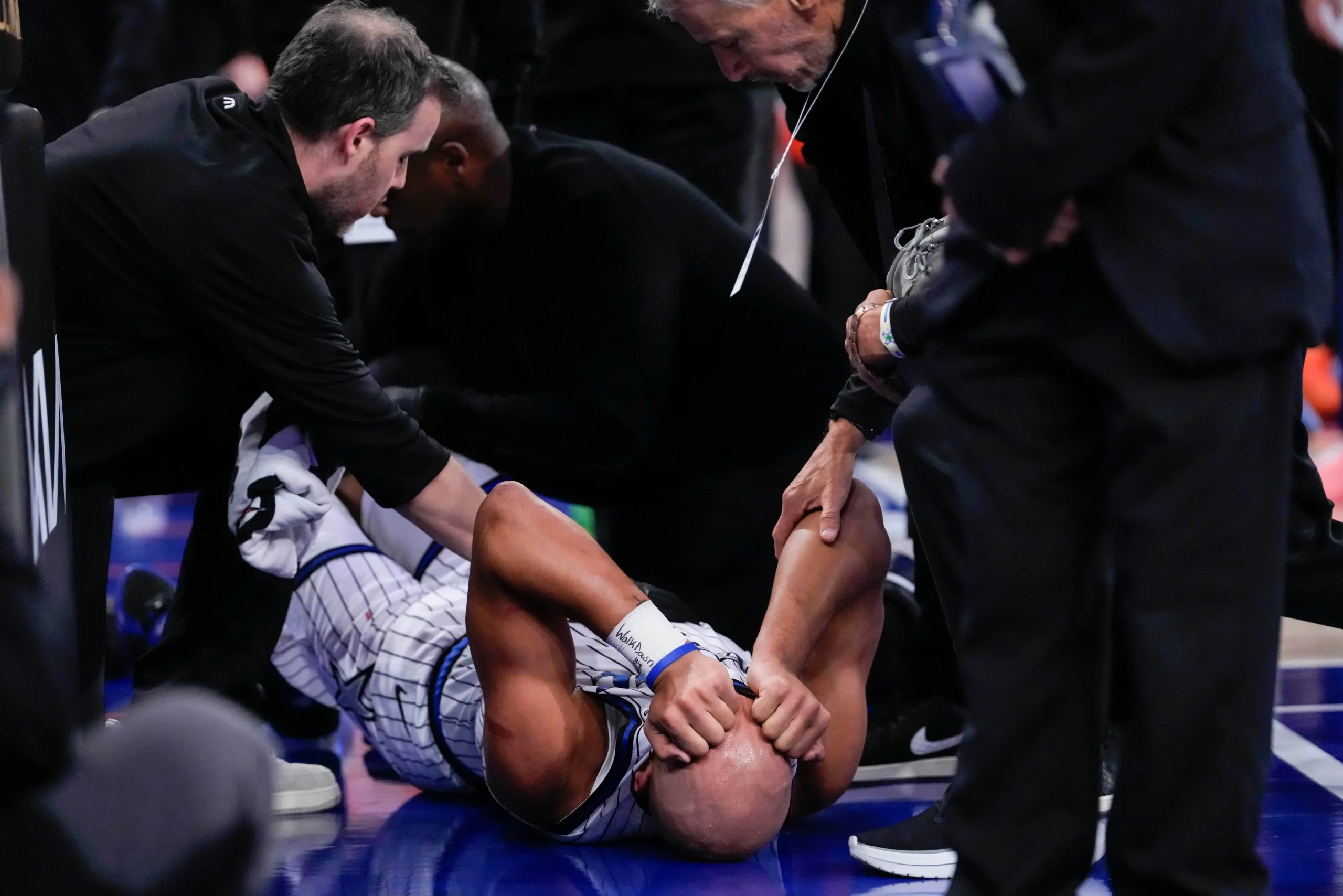
image via Orlando Sentinel
The 2026-27 NBA season is just getting started, yet the league is already facing a concerning early-season storyline: player availability.
According to the October 28 injury report, 79 players carried an out, doubtful, questionable or probable designation related to an injury or illness ahead of that night’s games. That’s roughly 15% of the league’s player pool, putting the spotlight on a familiar debate: Is the NBA’s 82-game regular season asking too much of its athletes?
The number is striking, particularly this early in the season. However, the designations do not mean all 79 players were ruled out. Some remained questionable or probable, while others were unavailable to play.
Still, the volume raises an important question for a league that depends on its stars being healthy enough to compete: How much physical demand can NBA players reasonably be expected to handle over a full season?
Kenny Atkinson points to the modern NBA’s physical demands
Cleveland Cavaliers head coach Kenny Atkinson recently offered a perspective on why today’s game places such significant demands on players.
Atkinson pointed to the increasing intensity of defensive pressure, the physical battle for offensive rebounds and the repeated accelerations and decelerations required throughout a game.
Modern defenses frequently pressure ball handlers farther from the basket, forcing offensive players to work harder simply to advance the ball. At the other end, teams aggressively pursue offensive rebounds, creating additional physical contact and demanding repeated efforts.
As Atkinson explained, players must repeatedly meet that intensity because backing off can give opponents a competitive advantage.
His central point was that coaches face a difficult balancing act: They want their teams to compete at the highest level, but demanding maximum effort on every possession throughout an 82-game season carries a physical cost.
Atkinson also emphasized that coaches must determine the appropriate level of intensity rather than expecting players to give everything on every play.
That perspective adds another dimension to the injury discussion. The issue is not necessarily the number of games alone, but also the pace, intensity and cumulative workload involved in playing them.
The 82-game grind: More than just game nights
The NBA’s regular season typically spans approximately six months, with each team scheduled to play 82 games before the playoffs.
That schedule involves more than the minutes players spend on the court. Athletes must also navigate practices, strength and conditioning sessions, road trips, changing time zones and limited recovery windows between games.
Research examining NBA training and game demands has highlighted the volume of activity players accumulate across a season, including substantial on-court work outside of competition.
Back-to-back games and congested stretches can make recovery more difficult, particularly when travel is involved. A player may finish one demanding game, travel to another city and be expected to perform at a high level again the following night.
The demands also vary by player. Starters generally carry heavier game workloads than reserves, while age, previous injuries, playing style and individual physical characteristics can affect how athletes respond to a long season.
This is why the injury conversation cannot be reduced to the schedule alone. A combination of workload, recovery, contact, individual health and chance can influence whether a player gets hurt.
Should the NBA shorten its regular season?
The early injury numbers inevitably raise the question of whether the NBA should consider reducing the number of regular-season games.
Supporters of a shorter schedule argue that fewer games could create additional recovery opportunities, reduce travel demands and potentially improve the chances of seeing star players available for important matchups.
A shorter season could also make individual games feel more consequential while giving teams more time to prepare for the postseason.
However, reducing the schedule would bring trade-offs. Teams, players and the league would have to consider lost regular-season revenue, broadcast commitments, ticket sales and the value of an extensive schedule that gives fans multiple opportunities to see their teams.
And there is an important distinction: A shorter season might reduce total exposure to games, but it would not automatically eliminate injuries. Basketball involves sudden changes of direction, jumping, landing and physical contact, all of which carry inherent risks.
The evidence also does not establish that every early-season injury is caused by fatigue or the 82-game schedule. Some injuries occur through unavoidable contact or awkward movements, even when a player has adequate recovery time.
Any decision to change the schedule would therefore require careful consideration of both player health and the broader economics of the league.
Is load management enough?
The NBA has already confronted the challenge of balancing player rest with fan expectations.
Load management, in which teams strategically limit a player’s workload or schedule rest, has become a prominent part of that discussion. The league’s Player Participation Policy, introduced in 2023, established restrictions intended to promote star-player availability and discourage certain forms of strategic rest.
But rest is not a guaranteed safeguard against future injuries.
A 2026 observational study examining NBA data from the 2014-15 through 2022-23 seasons found that players who missed games for rest or load management did not have a statistically significant reduction in subsequent injury risk during the same season. The researchers noted that further work incorporating training and internal workload measures could provide additional insight.
That finding does not mean rest has no value. It means the relationship between rest and injury prevention is complicated, and simply sitting players for a predetermined number of games may not address every risk factor.
Teams must consider the complete picture: minutes played, practice intensity, travel, previous injuries, recovery and the demands of each player’s role.
Better workload monitoring and individualized recovery plans may be as important to the conversation as the number of games on the schedule.
The impact on players, teams and fans
The consequences of injuries extend well beyond a team’s medical staff.
When a franchise loses a leading scorer, defensive anchor or primary playmaker, its rotations and game plans can change dramatically. Teammates may have to take on additional minutes, while younger players and reserves face greater responsibilities.
For fans, injuries can mean missing the opportunity to see star players in person or watch marquee matchups at full strength. For players, serious injuries can threaten career longevity, disrupt development and require months of rehabilitation.
The timing of this early-season wave makes the situation especially noteworthy. The NBA is still in the opening stages of the campaign, and teams have a long schedule ahead before the postseason begins.
Yet the October 28 report is only a snapshot of player availability on one day. It does not, by itself, establish a long-term increase in injuries or prove that the league’s schedule is responsible.
The more useful question is whether the league can identify patterns across multiple seasons and use that information to make evidence-based decisions about workload, recovery and scheduling.
What should change?
The NBA faces a difficult challenge: preserving the intensity and competitiveness that make the sport compelling while protecting the athletes responsible for delivering it.
A shorter season is one potential solution, but it is not the only option. The league and its teams could also examine scheduling congestion, travel demands, practice workloads, recovery resources and the effectiveness of current player-rest policies.
Atkinson’s comments highlight a challenge coaches encounter every night. Teams are expected to compete at an elite level, and the pressure to match an opponent’s intensity can make it difficult to conserve energy over the course of a long season.
Ultimately, player health cannot be separated from the way the modern NBA is played.
With 79 players carrying injury or illness designations on a single early-season report, the conversation about the NBA’s physical demands is worth having. The bigger question is whether the league can find ways to protect player health without compromising the competition fans pay to see.
What do you think?
Should the NBA reduce its 82-game regular season, or should the league focus on better scheduling, recovery and workload management instead?
Join the conversation in the comments.