
By Hodari P.T. Brown | October 7, 2026
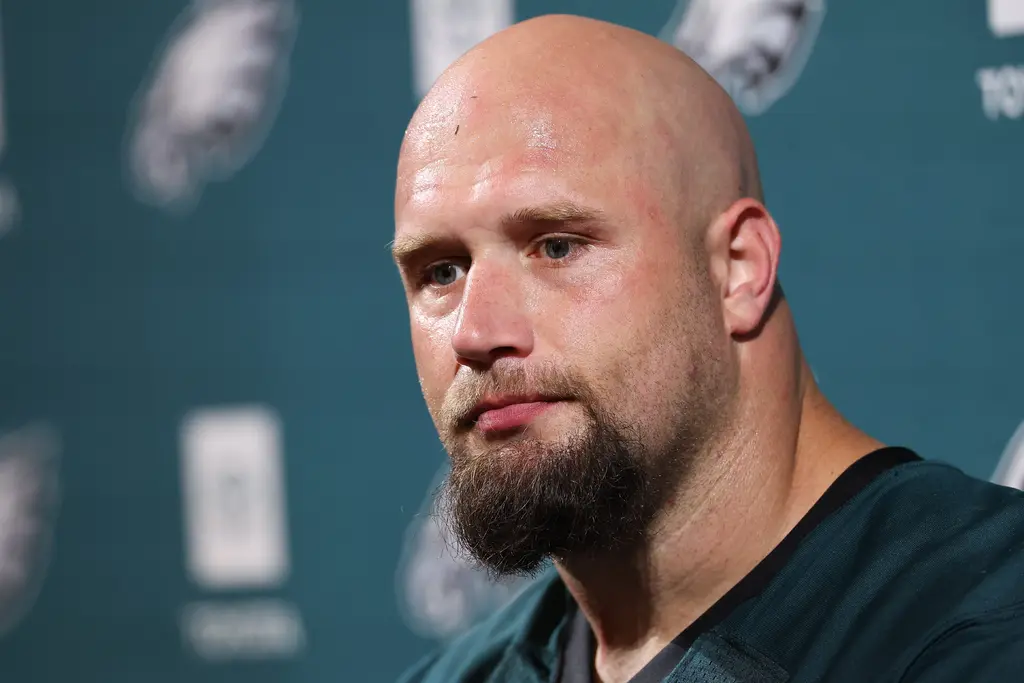
When Philadelphia Eagles offensive tackle Lane Johnson announced his abrupt retirement from the National Football League after 14 seasons, the conversation should have centered on his courage, his well-being, his family, and the reality that professional athletes are human beings before they are entertainers. Instead, ESPN’s Stephen A. Smith turned Johnson’s decision into a controversial discussion about the timing of his retirement and the Eagles’ disappointing start to the season.
During Wednesday’s episode of ESPN’s First Take, Smith questioned why Johnson would retire just four games into the season rather than during the offseason. His commentary appeared to suggest that Philadelphia’s struggles contributed to Johnson’s decision to walk away. Fellow ESPN personality Kimberley Martin challenged the implications of his remarks, prompting Smith to clarify that he was not attempting to minimize mental health concerns. Nevertheless, the exchange raised legitimate questions about how sports media discusses mental health and the responsibility that comes with having a national platform.
Johnson is not some inexperienced player who suddenly decided professional football was too difficult. He is a two-time Super Bowl champion, six-time Pro Bowl selection, and one of the most respected offensive linemen of his generation. He has dedicated nearly a decade and a half of his life to the Eagles organization, endured injuries, played through physical adversity, and established himself among the best at his position.
Yet none of those accomplishments makes him immune to depression, anxiety, emotional exhaustion, family struggles, or the psychological pressures that millions of Americans experience every day.
In announcing his retirement on October 6, Johnson explained that his personal and family priorities had changed and that focusing on his mental health had become critical. That should have been enough for people to respect his decision without questioning his commitment to football.
What makes Smith’s commentary particularly troubling is the family circumstances surrounding Johnson’s decision. Johnson had previously acknowledged health concerns involving his mother, circumstances that deserve consideration when discussing why a professional athlete might need to prioritize family over football. Reports have also circulated about additional family health challenges, although specific claims concerning his mother’s cancer diagnosis, his father’s condition, and travel plans have not all been independently confirmed.
That distinction matters because the broader point does not require speculation about Johnson’s private family circumstances. He has already publicly explained that his mental health and family must come first.
And sometimes the most difficult battles people face have absolutely nothing to do with their careers.
A person can be financially successful and emotionally overwhelmed. Someone can earn millions of dollars and still experience anxiety about losing a parent. A person can be celebrated by thousands of fans every Sunday and still feel isolated, exhausted, frightened, or emotionally depleted when the stadium lights go out.
Money does not prevent cancer. Fame does not eliminate grief. Professional accomplishments do not protect someone from depression. Athletic ability does not make anyone immune to mental illness.
This is precisely why the story of Atlanta Falcons defensive lineman Za’Darius Smith deserves to be part of this national conversation.
In 2025, while playing for the Philadelphia Eagles, Za’Darius Smith received devastating news about his mother’s declining health. According to his own account, her physician informed him that she did not have much time left to live. Smith explained that he notified the Eagles about the situation but felt the organization was unwilling to allow him to leave as he needed. Faced with choosing between football and spending precious time with his mother, he retired.
Smith’s mother, Sharon, subsequently passed away in February 2026. He also endured the deaths of his father and grandmother during that painful period. His decision to leave football was not about losing his competitive spirit. It was about confronting the possibility of losing someone who meant more to him than any football contract, championship, or professional accomplishment.
Imagine being placed in a position where the profession you love conflicts with the opportunity to spend time with a dying parent. Imagine knowing that every passing day could represent another memory you will never have the opportunity to create.
For many people, that is not a hypothetical situation. It is a painful reality.
Smith eventually returned to professional football in 2026, signing with the Atlanta Falcons. His return carried a meaning far greater than another NFL contract. Atlanta was closer to his Alabama roots, and his mother had always hoped he would someday play for the Falcons.
During his first home game with Atlanta, Smith arranged transportation for members of Harrison Street Baptist Church in Greenville, Alabama, his mother’s church, to attend the game. Approximately 45 people traveled by bus to support him, fulfilling a wish his mother had carried for years. He also provided tickets and other gifts to the congregation.
It was a powerful reminder that football was never simply about football. It was about family, faith, love, remembrance, and honoring the woman who helped shape his life.
These two stories should challenge the way we discuss professional athletes and mental health.
Too often, society treats athletes as commodities rather than human beings. Fans purchase tickets, jerseys, and merchandise, television networks negotiate billion-dollar broadcasting agreements, and sports commentators earn substantial salaries debating athletes’ performances. Yet when those same athletes experience personal difficulties, the conversation frequently shifts toward whether they are mentally tough enough, committed enough, or sufficiently grateful for their financial opportunities.
That mindset is dangerous.
Mental health does not discriminate based on income, race, gender, profession, education, religion, or social status. A professional athlete earning $20 million annually can experience the same grief, anxiety, depression, or emotional distress as a teacher earning $50,000, a factory worker facing layoffs, a veteran struggling with trauma, or a parent trying to support a family.
Their circumstances may be different, but their humanity is not.
It is also important to understand that mental health and mental illness are related but not interchangeable. Everyone has mental health, just as everyone has physical health. Not everyone experiences a diagnosable mental illness, but everyone can encounter periods of emotional distress, grief, psychological exhaustion, or overwhelming stress.
We cannot determine someone’s mental health simply by looking at their bank account, watching their professional performance, or observing how they behave publicly.
Someone can smile during an interview while struggling privately. Someone can appear confident in front of thousands of people while experiencing significant emotional distress. Someone can continue showing up for work while carrying burdens that nobody around them understands.
And someone can decide that continuing to work is no longer worth sacrificing their psychological well-being.
That decision should not automatically be interpreted as weakness.
For Johnson, stepping away from football may represent one of the most important decisions of his life. For Za’Darius Smith, temporarily walking away allowed him to prioritize family during an irreplaceable period. Their circumstances are not identical, and neither athlete’s private mental health should be reduced to a convenient television narrative.
This is where ESPN and Stephen A. Smith have an opportunity to demonstrate leadership rather than simply defend controversial commentary.
Smith has built an enormously successful career through passionate opinions, provocative debates, and an unmistakable television personality. His influence reaches millions of viewers across different generations and communities. With that influence comes a responsibility to recognize when a conversation requires more than entertainment.
If ESPN intends to devote substantial airtime to an athlete’s mental health, the network should consider including licensed psychologists, psychiatrists, sports psychologists, mental health advocates, and former athletes who can provide informed perspectives.
Mental health should not become another segment designed primarily to generate viral clips, social media arguments, and television ratings.
ESPN should also consider developing stronger editorial practices for discussions involving mental illness, suicide prevention, grief, family trauma, and emotional distress. Sports commentators do not have to become mental health professionals, but they should recognize the limitations of their expertise and avoid implying that an athlete’s mental health concerns are less legitimate because of a team’s record or the timing of a retirement announcement.
Furthermore, Stephen A. Smith and ESPN should consider making meaningful financial contributions to organizations working to improve mental health awareness, treatment access, crisis intervention, and suicide prevention.
Organizations such as the National Alliance on Mental Illness, Mental Health America, the American Foundation for Suicide Prevention, and community-based mental health programs could benefit from increased visibility, resources, and partnerships with major sports media organizations.
This should not be viewed simply as a demand for punishment or an attempt to silence Smith. Rather, it is an opportunity to transform a controversial television moment into meaningful public education.
Imagine ESPN dedicating a First Take segment to discussing the mental health challenges facing professional athletes, military veterans, working parents, and everyday Americans. Imagine a conversation featuring former NFL players who have experienced depression, anxiety, grief, or emotional exhaustion alongside qualified mental health professionals who could explain warning signs, treatment options, and available support.
That would be a far more meaningful contribution than debating whether Lane Johnson should have waited until the offseason to retire.
There is also a broader lesson for professional sports organizations. The NFL and its teams must continue examining how they support players experiencing family emergencies, grief, and mental health challenges. When athletes are confronted with serious illness or death within their families, organizations should respond with compassion, flexibility, and practical support.
A football team can replace an offensive lineman or defensive end on its roster. A son cannot replace his mother or father.
A season can be disappointing. A championship opportunity can be lost. A contract can expire. But time with a dying parent cannot be recovered once it is gone.
As someone who believes strongly in mental health advocacy, I find these conversations especially important because the consequences extend far beyond professional sports. The language we use when discussing mental health can influence whether someone feels comfortable seeking counseling, acknowledging depression, requesting assistance, or admitting they are struggling.
When prominent personalities appear to question the legitimacy of mental health concerns, even unintentionally, that message can reinforce the stigma that prevents people from asking for help.
We should be encouraging people to recognize their limitations, seek professional support when necessary, establish healthy boundaries, and prioritize their well-being before reaching a crisis.
We should also recognize that grieving a loved one, caring for an ill parent, or confronting personal emotional challenges does not follow a convenient schedule.
Depression does not wait until the offseason. Anxiety does not disappear because a team is undefeated. Grief does not respect television contracts. Cancer does not schedule itself around playoff appearances.
And mental health does not suddenly become important only when someone’s suffering reaches a breaking point.
Stephen A. Smith has every right to analyze the Philadelphia Eagles, criticize their performance, and question organizational decisions. That is part of his profession. However, there is a meaningful difference between criticizing a football team’s performance and publicly questioning the circumstances surrounding an individual’s decision to prioritize his mental health.
Johnson has earned the right to walk away from professional football without having to convince television commentators that his reasons are sufficiently legitimate.
Za’Darius Smith’s story reminds us that sometimes walking away is not the end of a person’s journey. Sometimes it creates the opportunity to heal, grieve, reconnect with family, and eventually rediscover joy.
And sometimes walking away permanently is equally deserving of respect.
The NFL is a multibillion-dollar industry, but its players are not machines. They are sons, fathers, husbands, brothers, friends, and human beings who experience the same emotional challenges as the people watching them every Sunday.
We must stop measuring someone’s mental toughness by how much pain they are willing to conceal.
We must stop assuming that financial success eliminates emotional suffering.
We must stop treating mental health as an inconvenience when it interrupts entertainment.
And we must recognize that prioritizing mental health is not necessarily quitting on life, abandoning responsibility, or demonstrating weakness. Sometimes it is an act of self-awareness, courage, and survival.
Lane Johnson owes football nothing more. Za’Darius Smith owed football nothing more when his mother needed him. And no professional athlete should have to sacrifice their humanity to satisfy the expectations of fans, television personalities, or billion-dollar organizations.
The most important question surrounding Johnson’s retirement should not be why he walked away after four games.
It should be whether we have created a culture where people feel supported enough to acknowledge when they need help, before their struggles become unbearable.
Because long after the final whistle, the television ratings, the championship celebrations, and the debates on ESPN, life continues.
And ultimately, mental health matters more than football.
If you or someone you know is experiencing emotional distress or a mental health crisis, call or text 988 to connect with the Suicide & Crisis Lifeline. Support is available 24 hours a day.