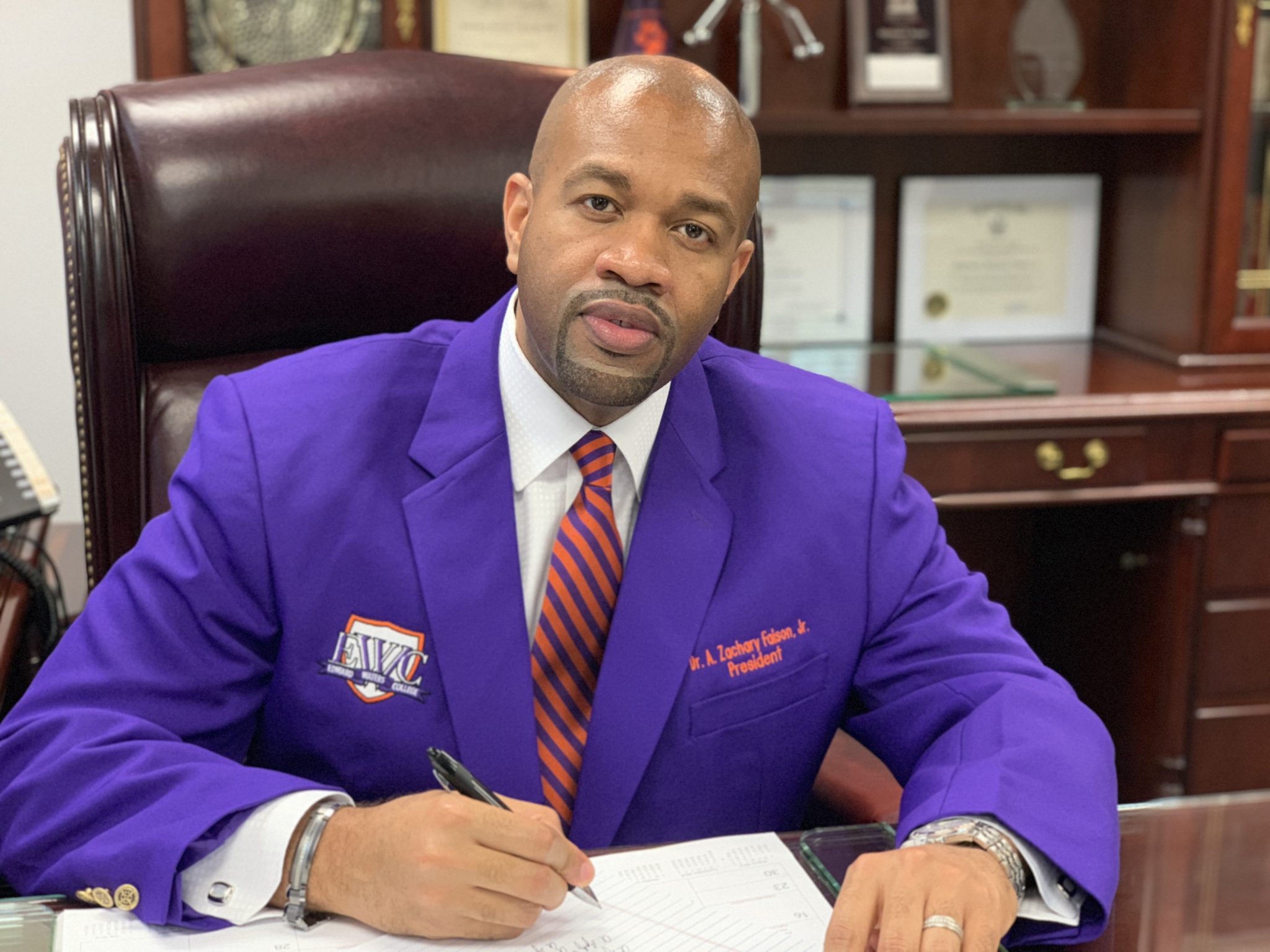
JACKSON, Miss. — Edward Waters University President and CEO A. Zachary Faison Jr., Ed.D., J.D., is taking responsibility for the decision to schedule Saturday’s matchup against Jackson State — and says the university will take a dramatically different approach to Division I football games moving forward.
Following Edward Waters’ 66-14 loss to Jackson State in the 2026 season opener, Faison issued a lengthy message to the university’s student-athletes, coaches, athletics administrators and supporters in which he defended the Tigers’ effort while openly questioning whether the financial and competitive realities of Division I guarantee games make sense for the NCAA Division II program.
“I am proud of you,” Faison wrote to the Edward Waters players. “You fought. You did not quit.”
But Faison also offered an unusually direct admission.
“I owe you an apology, because the position we placed you in Saturday was not your doing and it was not your coaches’. The decision was mine, and I own it.”
EWU Says the Economics Didn’t Make Sense
According to Faison, Edward Waters received a $65,000 guarantee for the Jackson State game.
However, he said travel and related expenses totaled approximately $30,000 to $35,000, leaving the university with roughly $30,000 after expenses.
For Faison, that amount isn’t sufficient compensation for what the game demands from the football program.
“That does not begin to justify what such a game asks of a team, a coaching staff, and a program,” Faison wrote.
The president said EWU’s concern extends beyond the financial equation.
He pointed to the scholarship disparity between Division II and FCS programs, noting that Edward Waters currently has 29 funded football scholarships, while the NCAA Division II limit is 36 and the FCS limit is 63.
“When we put 29 funded scholarships on the field against an FCS limit of 63, we are not being measured,” Faison wrote. “We are being mismeasured.”
Faison also emphasized that Edward Waters’ scholarship investment compares favorably within the SIAC and argued that the disparity should not be interpreted as a lack of institutional commitment to football.
‘It Is Different’ — Not Superior
Perhaps Faison’s strongest argument centered on recruiting.
He believes lopsided losses against Division I opponents can create a misleading perception when prospective student-athletes compare Division I and Division II opportunities.
“That result then follows our coaches into living rooms during recruiting season,” Faison wrote, arguing that a young player may see a Division I scoreboard and conclude that the Division I program is inherently better.
His response was blunt:
“It is not superior. It is different. Superior and different are not synonyms.”
Faison said he does not want Edward Waters continuing to provide prospective recruits with what he considers an unfair comparison.
HBCU Guarantee Games Become Part of the Debate
Faison contrasted Edward Waters’ $65,000 guarantee with the substantially larger payouts received by several HBCU Division I programs for playing Power Four opponents.
He cited reported guarantees including:
| HBCU | Opponent | Reported Guarantee |
| Florida A&M | Miami | $740,000 |
| Morgan State | Arizona State | $600,000 |
| Tennessee State | Georgia | $600,000 |
| Arkansas-Pine Bluff | Missouri | $550,000 |
| Howard | Indiana & Rutgers | Approximately $1 million combined |
Faison also referenced an unnamed HBCU program that received $1 million to play Ohio State last season.
His point wasn’t that HBCU Division I programs shouldn’t accept those opportunities. Instead, he argued that the financial return can fundamentally change the equation.
“Tennessee State is the clearest illustration,” Faison wrote.
He pointed out that Tennessee State lost to Jackson State by two points the previous week before suffering a 63-3 defeat at Georgia.
Yet, unlike Edward Waters’ situation against Jackson State, Tennessee State reportedly received $600,000 for its Georgia matchup.
“That is a defensible trade,” Faison wrote. “Ours was not.”
Edward Waters Establishes a New Financial Standard
Faison isn’t simply criticizing the previous scheduling decision. He laid out specific financial parameters for future Division I football games.
“My keys do not begin to rattle for anything that nets this institution less than $100,000 after travel and related costs,” he wrote.
Even reaching that $100,000 threshold, however, would not automatically result in Edward Waters accepting a game.
Faison said the university will not play a Division I opponent for less than 35% of the guarantee that institution itself receives for its own Power Four game.
“If a program is collecting $600,000 to absorb that treatment, it can pay a proportional share to ask the same of us,” Faison wrote.
“Below that, the conversation does not start.”
That represents a significant change in philosophy for Edward Waters football.
EWU Also Wants to Limit NAIA Matchups
Faison said the university’s scheduling philosophy will apply in the other direction as well.
Edward Waters will generally avoid scheduling NAIA opponents in football except under what he described as “compellingly rare circumstances.”
His reasoning is tied to postseason implications.
“When we win, we receive no credit toward NCAA Division II postseason eligibility. When we lose, we absorb a reputational cost we cannot recover,” Faison wrote.
“There is virtually no version of that game that advances this institution.”
Instead, Edward Waters intends to concentrate its nonconference scheduling on opponents that operate within the same NCAA Division II competitive structure.
‘We Will Schedule Where We Belong’
Faison specifically identified the CIAA, SIAC, Conference Carolinas and Gulf South Conference as potential scheduling partners because of their geographic proximity and Division II status.
“We will schedule where we belong and where we can win,” he wrote.
The message represents more than a reaction to one difficult Saturday.
Faison acknowledged that Edward Waters’ players and coaching staff did not create the circumstances surrounding the Jackson State matchup.
He said the administrative decision to schedule the game was his — and that he intends to change it.
“Our reputational standing will never be diminished by any failure of our players or our staff,” Faison wrote. “Saturday it was arguably diminished by an administrative decision I made, and I am not going to keep making it.”
Protecting the Players Beyond the Scoreboard
Faison also addressed something that doesn’t show up in a box score: the potential mental and psychological impact of playing a game in which the competitive circumstances are heavily tilted toward the opponent.
He expressed relief that Edward Waters emerged from the Jackson State game without significant physical injury while emphasizing that the effects of such contests can extend beyond what appears on an injury report.
“That kind of harm does not appear on an injury report, and it is precisely the harm I am no longer willing to risk for $30,000,” Faison wrote.
Despite the loss, Faison made clear that he has not lost confidence in the Tigers or the program’s direction.
“Everything is still in front of this team this season,” he wrote.
He closed his message by turning the page toward the remainder of the season:
“Let’s get ready for Miles!”
The Bigger HBCU Football Question
Faison’s comments raise a broader question for HBCU football: At what price does a guarantee game become worth the competitive, physical and reputational risk?
For FBS and FCS programs, these games can provide valuable revenue. For Division II programs, however, the financial calculus can look considerably different when the payout is relatively small compared with travel expenses and the competitive disparity.
Edward Waters has now established its position.
The university isn’t necessarily closing the door on Division I opponents.
It’s saying that if Division I wants Edward Waters on the schedule, the financial terms must reflect what is being asked of the Tigers.
And according to Faison, that conversation now starts at $100,000 net — and potentially much higher depending on the opponent’s own guarantee-game economics.
For Edward Waters, Saturday’s 66-14 loss may ultimately become more than a difficult season opener.
It could mark the beginning of a completely different philosophy for how the university schedules football.