written by SST contributor Dr. Hodari P. T. Brown
For more than two decades, LeBron James has rewritten the NBA record book.
He has become the NBA’s all-time leading scorer. He ranks among the all-time leaders in assists, minutes played, playoff points, playoff wins, and nearly every cumulative statistical category imaginable. His longevity has allowed him to surpass legends such as Michael Jordan, Kobe Bryant, Karl Malone, Kareem Abdul-Jabbar, Tim Duncan, and many others in career totals.
Those accomplishments deserve recognition.
Very few athletes in any sport have maintained an elite level of play into their 40s. That type of consistency requires extraordinary discipline, physical conditioning, and adaptability.
Yet the conversation surrounding LeBron James often highlights only one side of the record book.
Rarely do fans or media discuss the records that reflect the cost of playing more games than anyone else.
If career totals matter when discussing greatness, then all career totals should matter.
Not just the favorable ones.
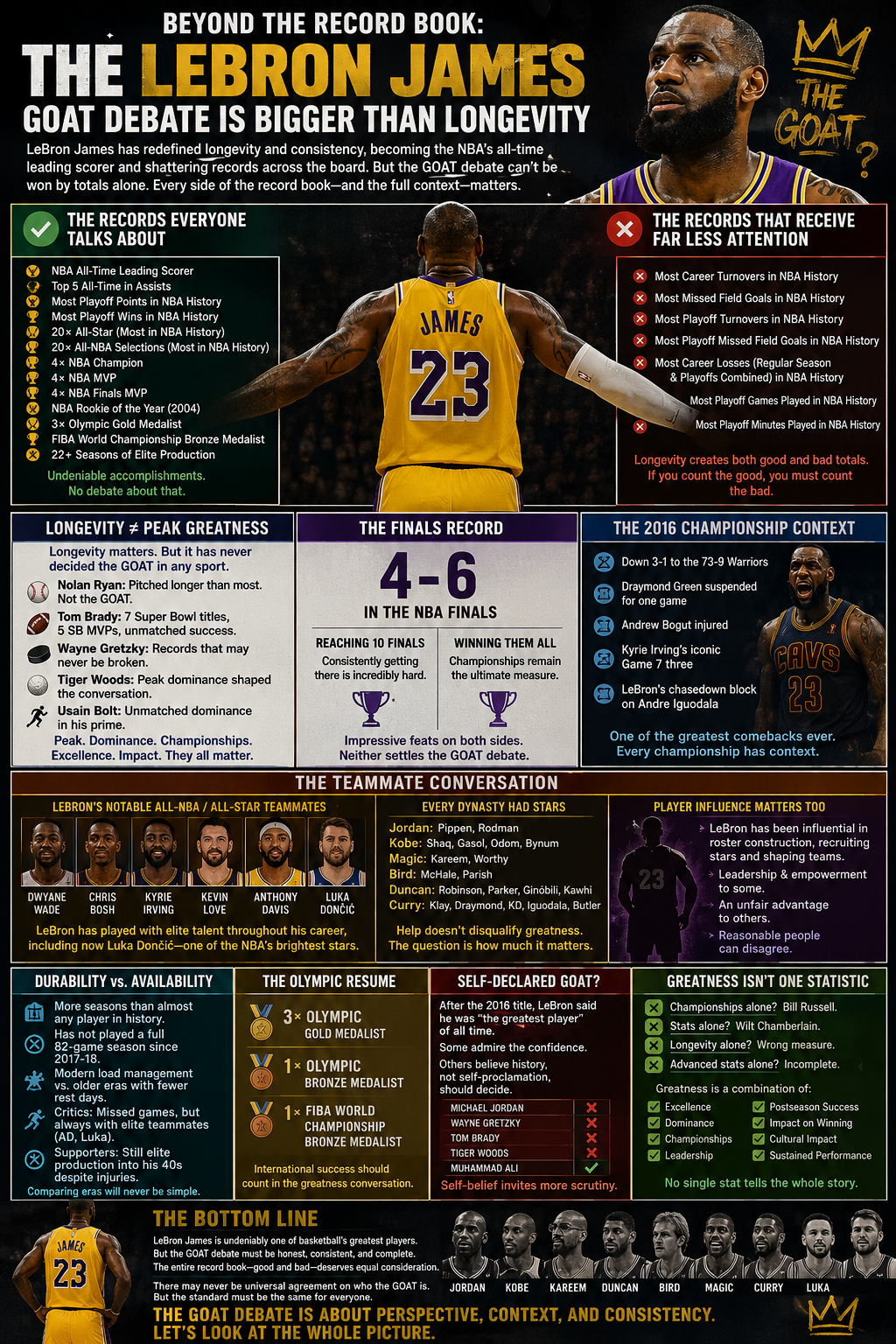
The Records Everyone Talks About
LeBron’s résumé is remarkable.
Among his accomplishments are:
- NBA all-time leading scorer
- Top five all-time in assists
- Most playoff points in NBA history
- Most playoff wins
- Most All-NBA selections
- Most All-Star selections
- Four NBA championships
- Four NBA MVP Awards
- Four NBA Finals MVP Awards
- NBA Rookie of the Year
- Three Olympic gold medals
- FIBA World Championship bronze medal
- More than two decades of elite production
Those accomplishments alone place him among the greatest players the sport has ever seen.
There should be no debate about that.
The Records That Receive Far Less Attention
However, longevity creates another reality.
The more games someone plays, the greater the opportunity to accumulate statistics that are less flattering.
LeBron also ranks at or near the top in several categories that rarely enter GOAT conversations.
Among them are:
- Most career turnovers in NBA history
- Most missed field goals in NBA history
- Most playoff turnovers
- Most playoff missed field goals
- Most career losses (regular season and playoffs combined)
- Most playoff games played
- Most playoff minutes played
These are not criticisms.
They are mathematical realities.
When someone plays more games than anyone else, they naturally accumulate both positive and negative totals.
Yet fans frequently celebrate one side of that equation while pretending the other side does not exist.
If cumulative statistics are the standard for greatness, consistency demands that all cumulative statistics be acknowledged.
Longevity Is Not the Same as Peak Greatness
One of the central arguments for LeBron’s GOAT candidacy is longevity.
He has remained productive longer than almost any player in NBA history.
That matters.
But longevity alone has never determined the greatest player in any sport.
No one calls Nolan Ryan the greatest baseball player simply because he pitched longer than nearly everyone else.
Tom Brady’s GOAT argument in football is not based solely on longevity. It includes seven Super Bowl championships, five Super Bowl MVP Awards, sustained excellence, and unmatched postseason success.
Wayne Gretzky’s hockey greatness is not simply about playing a long time. He owns records that many believe will never be broken.
Tiger Woods’ peak dominance continues to shape golf’s GOAT conversation despite Jack Nicklaus holding more major championships.
Usain Bolt’s greatness comes from unmatched dominance in sprinting, not career length.
Peak performance.
Dominance.
Championship success.
Individual excellence.
Impact on the sport.
All matter.
Longevity is only one piece of a much larger puzzle.
The Finals Record
Another topic often overlooked is LeBron’s NBA Finals record.
LeBron is 4-6 in the NBA Finals.
Supporters often argue that simply reaching ten Finals is itself an extraordinary accomplishment.
There is merit to that argument.
Making the Finals consistently is incredibly difficult.
Critics counter that championships remain the ultimate measure and point to Michael Jordan’s perfect 6-0 Finals record.
Both perspectives have validity.
Reaching the Finals repeatedly is impressive.
Winning every Finals appearance is equally impressive.
Neither accomplishment automatically settles the GOAT debate.
The 2016 Championship
For many supporters, the defining moment of LeBron’s career remains the 2016 NBA Finals.
Coming back from a 3-1 deficit against the 73-9 Golden State Warriors remains one of the greatest comebacks in sports history.
At the same time, critics point out several important circumstances surrounding that series.
Draymond Green served a one-game suspension after accumulating flagrant foul points.
Andrew Bogut missed time because of injury.
Kyrie Irving hit one of the biggest shots in NBA Finals history with his go-ahead three-pointer in Game 7.
LeBron’s chasedown block on Andre Iguodala became one of the defining defensive plays in league history.
Every championship contains context.
Jordan benefited from Hall of Fame teammates and arguably the greatest coach in NBA history.
Magic Johnson played with Kareem Abdul-Jabbar.
Larry Bird played alongside Kevin McHale and Robert Parish.
Tim Duncan won championships with David Robinson, Tony Parker, Manu Ginóbili, and later Kawhi Leonard.
Stephen Curry won titles with Klay Thompson, Draymond Green, Andre Iguodala, and Kevin Durant.
LeBron also played alongside elite teammates throughout much of his championship career.
Acknowledging context should not diminish championships, but it should remind us that no title is won in isolation.
The Teammate Conversation
Another overlooked aspect of the GOAT discussion is roster construction.
For much of his career, LeBron has played alongside All-Stars or All-NBA caliber teammates.
Examples include:
- Dwyane Wade
- Chris Bosh
- Kyrie Irving
- Kevin Love
- Anthony Davis
- Luka Dončić
The addition of Luka Dončić to the Los Angeles Lakers continues a pattern that has existed throughout much of LeBron’s career. Dončić is already one of the NBA’s brightest stars, a perennial All-NBA selection, multiple-time All-Star, scoring champion, and a player who has already led a team to the NBA Finals before turning 26. Even in his 40s, LeBron once again finds himself sharing the floor with one of basketball’s elite talents.
That is not necessarily a criticism.
Championship teams almost always feature multiple stars.
Michael Jordan had Scottie Pippen and Dennis Rodman.
Kobe Bryant won championships with Shaquille O’Neal before later winning alongside Pau Gasol, Lamar Odom, and Andrew Bynum.
Magic Johnson had Kareem Abdul-Jabbar and James Worthy.
Larry Bird had Kevin McHale and Robert Parish.
Tim Duncan had David Robinson, Tony Parker, Manu Ginóbili, and Kawhi Leonard.
Stephen Curry has played with Klay Thompson, Draymond Green, Kevin Durant, Jimmy Butler, and others.
The point is not that LeBron had help.
Every all-time great did.
The question is whether the GOAT debate should also consider how often a player has competed with fellow superstars throughout his career.
Another layer to that discussion is player influence.
Throughout his career, LeBron has frequently been credited with helping shape team rosters, recruiting stars, and influencing organizational decisions.
Some view that as leadership and player empowerment.
Others argue it should be considered when comparing him to previous generations whose roster decisions rested almost entirely with front offices.
Like many aspects of the GOAT debate, reasonable people can disagree on how much weight that deserves.
Durability Versus Availability
Longevity also raises another question.
How much should availability factor into greatness?
LeBron has played more seasons than nearly anyone.
Yet he has also managed his workload differently than earlier generations.
He has not played a full 82-game regular season since the 2017-18 season.
Modern sports science, injury prevention, and load management have reshaped today’s NBA.
Critics point out that despite missing increasing numbers of regular-season games in recent years, LeBron has continued to play alongside elite teammates such as Anthony Davis and now Luka Dončić, players capable of carrying major responsibilities while he manages injuries and workload.
Supporters counter that remaining productive into his 40s despite those injuries is itself evidence of greatness.
Both perspectives have merit.
Earlier generations often played more games with fewer scheduled rest days, while today’s game is faster, more physically demanding, and supported by advances in sports medicine.
Comparing eras is never simple.
The Olympic Conversation
If career accomplishments define greatness, then international basketball should also matter.
LeBron’s résumé includes:
- Three Olympic gold medals
- One Olympic bronze medal
- FIBA World Championship bronze medal
Those accomplishments deserve inclusion when evaluating his entire basketball career.
The same standard should apply to every player.
Greatness should be measured across all levels of competition rather than selectively choosing which accomplishments strengthen an argument.
If NBA statistics are used to elevate one player, then Olympic and international achievements should also be part of the discussion.
Should a GOAT Campaign Be Self-Declared?
Another difference between LeBron and many sports legends is his willingness to publicly discuss his place in history.
Following Cleveland’s 2016 championship, LeBron said he believed that victory made him “the greatest player of all time.”
Some admired the confidence.
Others believed GOAT status should be determined by history rather than self-proclaimed.
Michael Jordan rarely campaigned publicly for the title.
Wayne Gretzky did not.
Tom Brady generally allowed championships to speak for themselves.
Tiger Woods rarely discussed himself that way.
Muhammad Ali remains one of the few legendary exceptions, famously declaring, “I am the greatest,” as both confidence and psychological warfare.
There is no rule for how athletes should view themselves.
But when an athlete publicly enters the GOAT conversation, it naturally invites greater scrutiny.
Greatness Cannot Be Reduced to One Statistic
Perhaps the biggest mistake in modern sports debates is reducing greatness to one measurement.
If championships alone determined the GOAT, Bill Russell’s 11 NBA championships would likely end the discussion.
If statistics alone determined greatness, Wilt Chamberlain’s numbers would be nearly impossible to overcome.
If longevity alone determined greatness, then simply playing longer than everyone else would outweigh dominance.
If advanced analytics alone determined greatness, the conversation would look entirely different.
Greatness is rarely that simple.
It is a combination of excellence, consistency, dominance, leadership, championships, postseason success, influence on winning, cultural impact, and sustained performance over time.
No single statistic can capture all of those qualities.
The Bottom Line
LeBron James has unquestionably earned his place among basketball’s greatest players.
That much is beyond dispute.
But the GOAT debate should not be built solely on favorable statistics while ignoring the less flattering records that naturally accompany unprecedented longevity.
His all-time scoring record matters.
So do his all-time turnovers.
His playoff wins matter.
So do his playoff losses.
His longevity matters.
So does his peak.
His championships matter.
So do his Finals defeats.
His NBA accomplishments matter.
So do his Olympic and international accomplishments.
None of those facts diminish LeBron’s extraordinary career.
Instead, they remind us that evaluating greatness requires intellectual consistency. If cumulative records are used to elevate one player above every other legend, then the entire record book, both positive and negative, deserves equal consideration.
Perhaps that is why the GOAT debate has endured for decades and likely always will.
It is not merely a debate about statistics.
It is a debate about what we value most: peak dominance or sustained excellence, championships or longevity, individual brilliance or team success, and whether greatness is measured by the totality of a career or by the highest level a player reached at his absolute best.
There may never be universal agreement on who deserves the title of the greatest basketball player of all time.
But whatever standard is applied, it should be applied consistently to every player, including LeBron James.